Why Mid-Market AI Integrations Still Fail in 2026
Key Takeaways
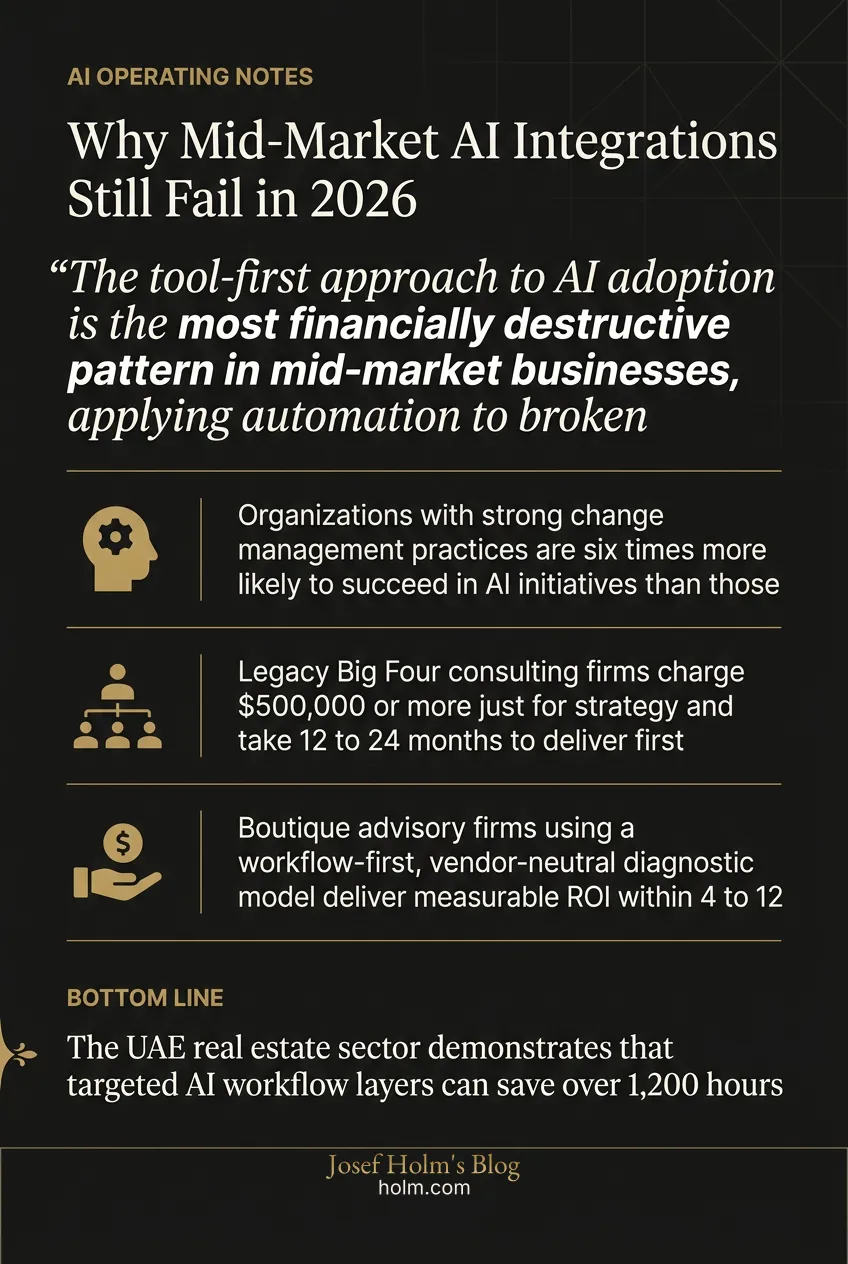
- The tool-first approach to AI adoption is the most financially destructive pattern in mid-market businesses, applying automation to broken workflows accelerates errors rather than fixing them.
- Organizations with strong change management practices are six times more likely to succeed in AI initiatives than those focused solely on technical installation.
- Legacy Big Four consulting firms charge $500,000 or more just for strategy and take 12 to 24 months to deliver first value, making them structurally misaligned with mid-market needs.
- Boutique advisory firms using a workflow-first, vendor-neutral diagnostic model deliver measurable ROI within 4 to 12 weeks at a fraction of the cost (strategy engagements starting around $7,500).
- The UAE real estate sector demonstrates that targeted AI workflow layers can save over 1,200 hours, compress lease cycles to 48 hours, and scale portfolios without a single new administrative hire.
Why Most Mid-Market AI Projects Fail Before They Start
Here's the uncomfortable truth. Nearly every mid-market company approaching AI in 2026 is making the same mistake, just from opposite directions. Some chase shiny tools. Others hire massive consulting firms. Both paths burn capital at alarming rates while delivering frustratingly little operational relief.
The real question isn't whether your business needs AI. That debate ended years ago. The question is whether you'll adopt it in a way that actually expands margins, or in a way that quietly drains your cash reserves while your team grows more cynical by the quarter.
Generative AI usage among adults skyrocketed to nearly forty percent within just two years of its mainstream introduction, an adoption velocity that far outpaces the historical integration curve of the early commercial internet. Yet enterprise integration, particularly in the mid-market, has repeatedly stalled. That gap between individual familiarity and organizational execution reveals something deeply broken in how businesses traditionally approach this kind of change.
What Happens When You Buy the Software First?
The most financially destructive pattern in AI adoption right now is what practitioners call the "tool-first" approach. It works like this: a business leader attends a conference, watches a compelling vendor demo, feels the competitive anxiety rising, and signs a software license before anyone has mapped the actual workflows the tool is supposed to improve.
This is backwards. Completely, dangerously backwards.
Applying sophisticated automation to broken, poorly documented workflows doesn't fix inefficiency. It accelerates error generation at algorithmic speed. The assumption that AI is some monolithic, plug-and-play solution you can layer on top of manual processes is a fantasy sold by vendors who profit from your confusion.
Small and medium businesses face constraints that make this approach especially toxic. They need measurable wins within weeks, not quarters. Their data lives scattered across emails, legacy spreadsheets, and disconnected CRM platforms, and they have almost no bandwidth for complex change management programs. When vendors push tools without establishing governance boundaries, access controls, or clear human review protocols, something predictable happens: shadow AI proliferates. Unmanaged applications spring up across departments, creating cybersecurity risks and data privacy exposure while failing to move the needle on any metric that actually matters.
Then the expensive tools sit unused. Employees find them more complicated than the manual processes they replaced.
Why Does Productivity Actually Drop After Deployment?
There's a well-documented economic phenomenon called the productivity paradox of AI adoption. Organizations frequently experience a severe, unexpected dip in overall productivity immediately after deploying new automated systems. This adjustment period demands intense process fine-tuning, infrastructure scaling, and a fundamental shift in how people interact with machine-generated outputs.
Longitudinal studies of operational firms show that organizations successfully weathering this "valley of despair" eventually outperform non-adopting peers in both productivity and market share. They only reach that point, though, if they built a change management framework before deployment began.
Most traditional implementations treat employees as endpoints for software installation rather than stakeholders in operational design. Rolling out complex systems without proper training, without clear communication about how the technology benefits individual daily workflows, and without structured engagement leads directly to resistance. Sometimes that resistance is loud. More often, it's passive-aggressive and quietly corrosive.
Organizations with strong change management practices are six times more likely to succeed in their AI initiatives than those focused solely on technical installation. Six times. That's not a marginal difference.
What About the Costs Nobody Mentions Upfront?
Beyond deployment failures and cultural resistance, the tool-first approach hides big long-term financial liabilities that most vendors conveniently forget to mention during their pitch.
Many mid-market enterprises assume their existing data infrastructure is "AI-ready." It almost never is. Data cleaning, normalization, and quality assurance protocols often consume vastly more resources than the algorithmic development itself. Without a diagnostic phase to surface these deficiencies, organizations stumble into months of delays reconciling inconsistent formats, bridging information gaps, and unifying siloed databases.
The second and third years of setup are frequently the most expensive phases, often exceeding initial year-one costs. While businesses optimistically anticipate declining expenses post-launch, the realities of ongoing refinement, maintenance, model drift correction, and computational scaling demand continuous capital investment. Data governance and regulatory compliance costs can easily add tens of thousands of dollars in unforeseen annual expenses. Organizations that skip the diagnostic phase find their AI budgets destroyed by hidden expenditures, turning a promised margin-expansion initiative into a capital sinkhole.
Is Hiring a Big Four Firm the Safer Bet?
Many mid-market leaders, terrified of the tool-first trap, swing to the opposite extreme. They engage a legacy multinational consulting conglomerate. The logic feels sound: these firms possess global resources, massive brand recognition, and deep expertise in enterprise-grade transformations.
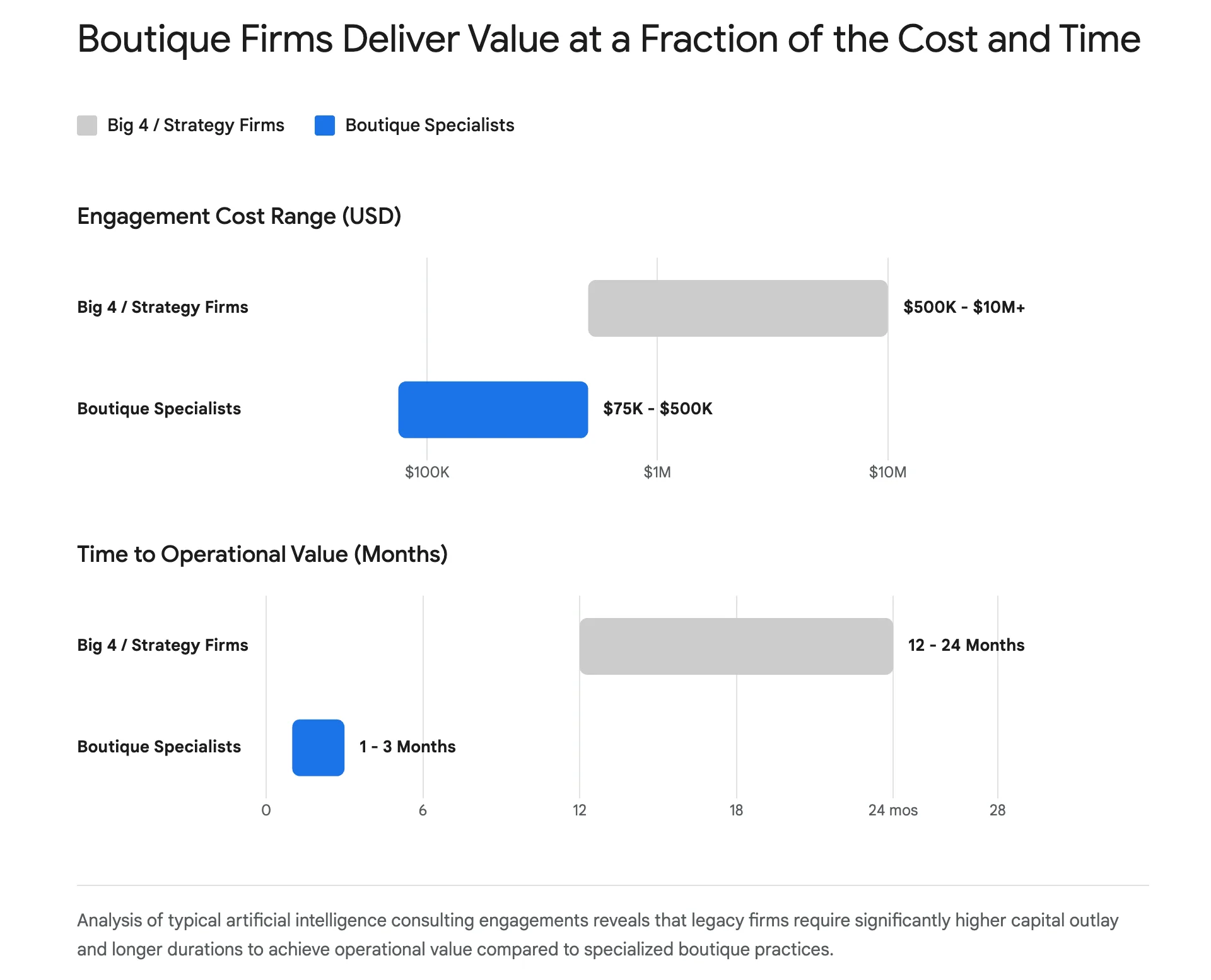
But their engagement models are fundamentally misaligned with mid-market realities. Can a company that bills three hundred and fifty to over six hundred dollars per hour, with strategy engagements starting at half a million dollars and implementations scaling into the three to ten million dollar range, genuinely serve a business that needs targeted relief from specific operational bottlenecks?
The disparity isn't about superior AI capabilities. It's a structural symptom of their business model: immense corporate overhead, lavish headquarters, complex partner compensation structures, and vast global infrastructure that must be sustained regardless of project scope. These firms have powerful incentives to expand every engagement. A localized bottleneck in accounts payable processing can easily be reframed as a multi-departmental digital transformation mandate, diluting focus and inflating the final price tag dramatically.
Who's Actually Doing the Work?
The traditional consulting delivery mechanism relies on the "pyramid model." Senior partners secure the engagement and provide high-level conceptual oversight. The actual execution falls to a broad base of junior associates and recent graduates. These junior staff may hold impressive academic credentials, but they routinely lack the deep, real-world operational experience needed to understand messy mid-market workflows.
Worth considering, too, are the timelines. A standard AI engagement with a major consultancy spans twelve to twenty-four months. During that protracted stretch of steering committees and slide deck generation, mid-market clients continue bleeding capital through administrative inefficiency. Targeted boutique engagements deliver first measurable value within four to twelve weeks, with full project completion often occurring within three to six months. When you factor in the operational savings generated during the months a boutique solution is actively running while a legacy firm would still be in discovery, the total differential in financial outcomes often exceeds hundreds of thousands of dollars in year one.
Speed to execution is an existential competitive advantage for flexible businesses. Legacy consulting structurally neutralizes it.
What Does a Workflow-First Approach Actually Look Like?
The boutique integration model practiced by firms like Josef Holm sits at the intersection of strategic advisory and ground-level technical rollout. It rejects generic AI education and theoretical frameworks in favor of operational clarity, evidence-backed recommendations, and rigorous commercial judgment.
The foundational principle is simple. Deep structural diagnosis must precede any technology purchase. Period.
Mid-market leaders are overwhelmed by noise. Every vendor promises transformation. Every competitor seems to be racing ahead. Expert advisory firms act as a protective barrier for organizational time and capital by establishing a heavily prioritized roadmap based on the unvarnished realities of actual daily operations. Leadership learns exactly what to execute, what to permanently defer, and what vendor hype to ignore before a single piece of software is engaged.
How Does the Diagnostic Phase Work?
This methodology is institutionalized through specialized engagements like the AI readiness note. Priced competitively for the mid-market, typically starting around seventy-five hundred dollars and concluding within two to four weeks, this diagnostic is the antithesis of a generic software demo.
It demands thorough executive intake led by senior advisors. Deep-dive workflow assessments map every human touchpoint in a process. Candid stakeholder interviews across key business functions assess true systems capabilities and data readiness. The objective is never to brainstorm speculative future use cases. It's to construct a pragmatic, integration-ready backlog that maps directly to measurable margin expansion and the immediate reduction of administrative drag.
Starting with how employees actually work today, rather than what AI tools exist on the market, keeps every recommendation grounded in commercial reality.
What Makes Governance-Lite Different from Enterprise Bureaucracy?
Legacy firms often institute crushing, multi-layered bureaucracy to manage risk. Progress grinds to a halt. The boutique alternative employs "governance-lite discipline," building in necessary guardrails, role-based access controls, and human-in-the-loop review mechanisms exactly where they matter most, without suffocating operational agility.
This model also champions selective rollout. It rejects the dangerous premise that an organization must transform every department simultaneously. Identified opportunities are ruthlessly prioritized based on a matrix of risk and technical feasibility, and the advisory mandate explicitly includes telling clients what to leave alone. Not every manual workflow benefits from automation. Some require the judgment, empathy, or strategic intuition that only a human operator can provide.
Businesses that begin with a tightly controlled pilot in a single high-pain department consistently achieve positive ROI three to five times faster than those attempting chaotic, company-wide rollouts.
Why Does Vendor Neutrality Matter So Much?
When a consultancy is financially incentivized to license a specific platform, the architectural advice will inevitably bend to justify that platform's inclusion. It doesn't matter whether simpler, vastly more cost-effective methods exist. The financial incentive warps the recommendation.
Leading boutique practitioners don't sell proprietary software. They don't accept referral fees or commissions from technology vendors. This strict financial independence guarantees that every recommendation focuses entirely on client margin expansion.
Vendor-neutral advisors protect client capital by working within the legacy systems, spreadsheets, and CRM platforms the business already trusts. The goal is embedding intelligence directly into existing, familiar workflows rather than forcing disruptive infrastructure replacements that shatter organizational morale.
How Do the Economics Actually Compare?
| Model Characteristic | Legacy Strategy Firms (Big 4) | Boutique Specialized Advisory (e.g. Josef Holm) | Independent Freelance | |-|-|-|-| | Primary Target Audience | Fortune 500, Global Enterprises | Mid-Market, Admin-Heavy Private Businesses | Early-Stage Startups, Micro-Businesses | | Typical Strategy Cost | $500,000+ | $30,000 - $80,000 | $10,000 - $30,000 | | Full Setup Cost | $3M - $10M+ | $75,000 - $500,000 | $50,000 - $150,000 | | Time to First Value | 12 to 24 Months | 4 to 12 Weeks | 8 to 16 Weeks | | Staffing Model | Heavy junior associate usage | Senior practitioners / Operator-led | Single specialist | | System Architecture | Total infrastructure replacement | Embedding within existing systems | Bespoke scripting, API connections | | Hourly Rate Averages | $350 - $600+ | $250 - $450 | $150 - $350 |
The most critical metric for mid-market leadership isn't initial capital outlay. It's velocity. Industry data confirms that the average SME AI build reaches positive ROI within four to eight months, provided it strictly targets high-volume, repetitive tasks like document processing, data entry, and routine client communication.
Reclaiming twenty hours per week from a finance team by automating payment reconciliation directly translates into margin expansion. The organization handles increased transaction volumes without equivalent headcount growth. That rapid value realization funds subsequent phases of the roadmap, creating a self-sustaining cycle of improvement rather than a multi-year cash drain.
What Does This Look Like in a Real Market?
The UAE real estate sector provides one of the most compelling proving grounds for workflow-first AI adoption. Dubai's population crossed four million in 2025 with broad projections to reach five million by 2030, generating intense, sustained pressure on housing and operational infrastructure.
Property management here carries entirely unique burdens. Extreme climate conditions place severe, continuous stress on structural assets, HVAC systems, and plumbing infrastructure. Operators manage highly diverse, multinational tenant populations requiring communication in English, Arabic, Hindi, Tagalog, and other languages. The Dubai Land Department has mandated sweeping digital transformation initiatives, introducing AI-powered advertising governance, smart valuation protocols, and mandatory digital compliance frameworks for lease registrations.
Generic software tools fail spectacularly in this environment. The bottlenecks are too specific.
Where Are the Biggest Wins Happening?
Mid-sized property management firms frequently drown in what practitioners call "WhatsApp maintenance chaos," where technicians, tenants, and portfolio managers attempt to route complex repair requests through consumer messaging apps. By deploying an intelligent workflow layer directly over these existing communication channels, firms have eliminated thousands of hours of manual routing. The AI system understands request context, triages severity based on historical data, and dispatches language-matched technicians without human intervention. Regional operators have expanded portfolios by hundreds of units without authorizing a single new administrative hire.
The lease renewal and compliance process represents another massive source of administrative drag. Corporate landlords often lose weeks to manual renewal drafting and risk severe non-compliance penalties. Intelligent document pipelines using computer vision and natural language processing have compressed processing cycles from weeks to forty-eight hours, achieving zero missed regulatory deadlines.
In high-volume off-plan sales, brokerages historically lost qualified international buyers due to delayed response times during major property launches. Invisible qualification layers that respond instantly, assess buyer intent, and route high-value prospects to specific human brokers have effectively halted lead leakage, securing multi-million dollar commissions that would have gone to competitors.
| Operational Vertical | Core Bottleneck | AI Solution | Measured Outcome | |-|-|-|-| | Property Management | WhatsApp maintenance chaos | Channel-native AI routing layer | 1,200 hours saved; 300+ units scaled, zero new hires | | Real Estate Leasing | Manual lease renewal and Ejari compliance | Intelligent document pipeline | Cycle compressed to 48 hours; zero regulatory penalties | | Real Estate Brokerage | Lead leakage in off-plan sales | Invisible qualification and routing layer | Response times under 2 minutes; high-intent buyers routed instantly | | Financial Operations | PDC cheque tracking and payment reconciliation | Intelligent matching layer | 85% drop in follow-up calls; 40 hours/month reclaimed | | Facility Management | Vendor invoice vs. purchase order validation | Strict matching workflow | Eliminated overpayments; 20 hours reclaimed weekly |
How Do You Build the Right Roadmap?
The symptoms of operational failure are universally recognizable to sharp leadership. Administrative overhead growing faster than revenue. Back-office processes breaking under increased transaction volume. Internal bottlenecks actively degrading client turnaround times. Routine data entry requiring excessive, error-prone human touches.
When leadership recognizes these signals but remains paralyzed by vendor noise, structured professional intervention becomes necessary.
The optimal roadmap explicitly avoids immediate software procurement. It demands engagement with a boutique advisory practice capable of executing a rigorous operational diagnostic without bias, culminating in an executive-ready roadmap and a granular, integration-ready backlog that dictates exact sequencing based on maximum commercial value and minimum organizational risk.
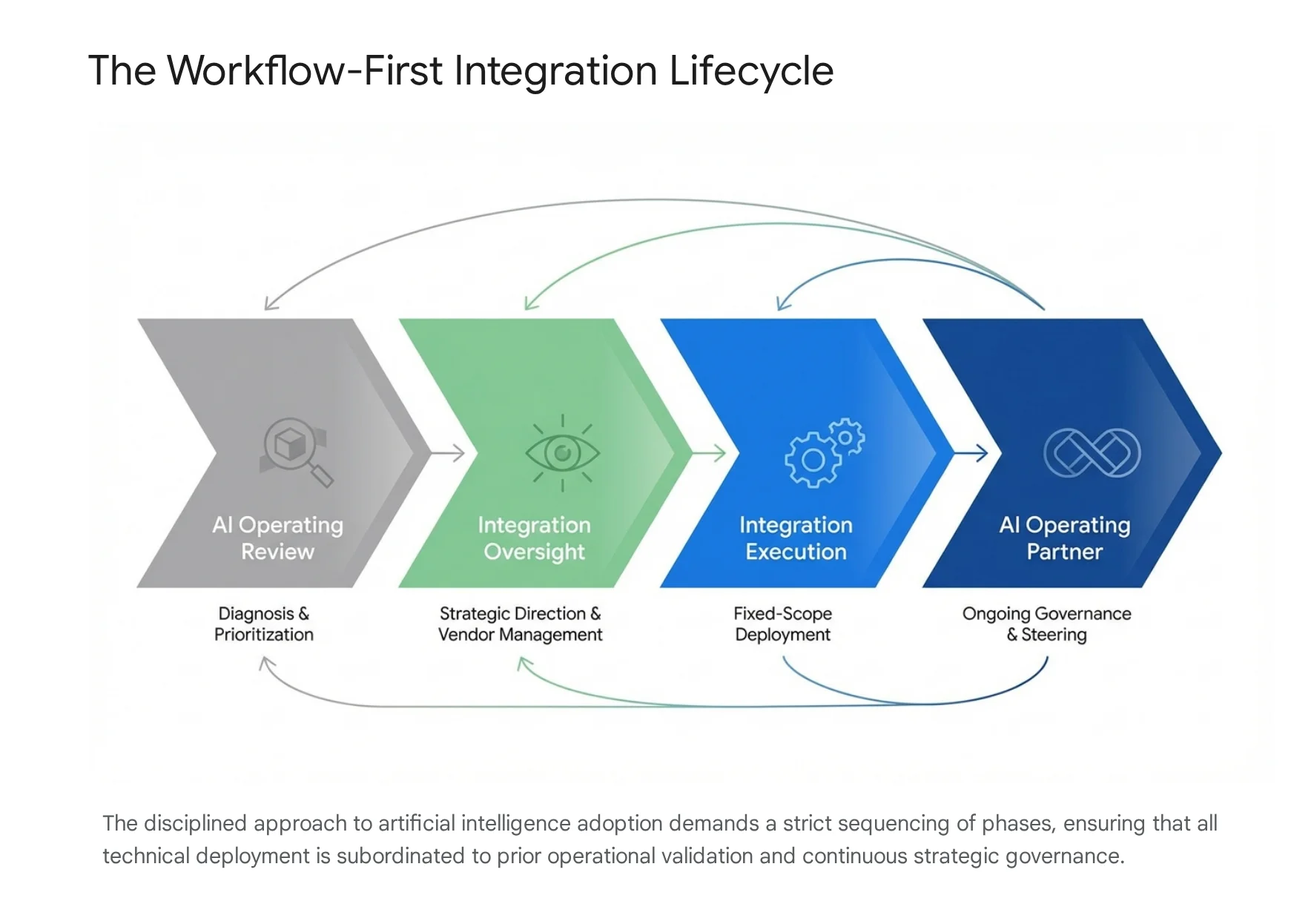
Following the diagnostic, three distinct pathways emerge. Organizations with internal developers but no strategic direction retain implementation notes to maintain decision quality and governance guardrails. Companies lacking technical personnel procure implementation notes to translate the roadmap into faster cycle times and immediate capacity creation through fixed-scope deployment. Businesses seeking long-term operational staying power secure an operator note for continuous strategic steering, model refinement, and human-centric adaptation as technology and market positions evolve.
This engagement model is not for everyone. Companies seeking free brainstorming, lacking a dedicated executive sponsor, or expecting overnight transformation across all departments without allocating a serious advisory budget are poor candidates. The boutique model is a selective practice built exclusively for operators who value commercial reality over technological experimentation.
Where Does the Real Competitive Advantage Live?
The most successful AI integrations are directed by people who possess deep pattern recognition about major technological shifts, not just academic familiarity with current models. The methodologies behind firms like Josef Holm are rooted in decades of digital business building, performance marketing, and venture capital experience. Leaders who built and scaled digital businesses to notable exits during the early commercial internet bring an investor perspective that is inherently focused on capital protection and rapid generation of defensible competitive advantages.
That depth of experience allows recognition of structural market shifts before they become mainstream consensus. Consider the current violent transition from traditional keyword search to generative, agentic search. As platforms like Google AI Overviews, Perplexity, and Microsoft Copilot replace traditional discovery mechanisms, the fundamental rules of brand visibility are changing permanently. Legacy SEO strategies are becoming largely obsolete.
An advisor with deep exposure to these developments can integrate advanced market positioning logic directly into a mid-market company's strategic roadmap, ensuring the client refines internal workflows for efficiency while simultaneously adapting its external digital posture for the realities of a machine-mediated economy.
The companies that win won't be the ones that adopt the most AI. They'll be the ones led by disciplined operators who exercise the strategic judgment to integrate it with absolute clarity about what actually drives margin.
Infographic
Frequently Asked Questions
- Why do most mid-market AI projects fail?
- Most mid-market AI projects fail because leaders adopt a tool-first approach, purchasing software before mapping the workflows it is meant to improve. Applying automation to broken or undocumented processes accelerates error generation rather than solving inefficiency. Without a diagnostic phase, change management framework, or governance guardrails, deployments stall, budgets inflate, and employee resistance grows.
- What is the productivity paradox of AI adoption?
- The productivity paradox refers to a well-documented dip in overall organizational productivity immediately after deploying new automated systems. This valley of despair requires intense process fine-tuning, infrastructure scaling, and behavioral shifts. Organizations that build a change management framework before deployment eventually outperform non-adopting peers, but only if they plan for this adjustment period in advance.
- How does a boutique AI advisory firm differ from a Big Four consultancy?
- Big Four firms target Fortune 500 enterprises with strategy engagements and full implementations ranging illion to $10 million or more, with timelines of 12 to 24 months. Boutique firms like Josef Holm serve mid-market businesses with strategy costs between $30,000 and $80,000, deliver first measurable value in 4 to 12 weeks, and use senior practitioners rather than junior associates for execution.
- What is a workflow-first approach to AI adoption?
- A workflow-first approach requires deep structural diagnosis of existing operations before any technology is purchased. Senior advisors map human touchpoints, assess data readiness, and conduct stakeholder interviews to build a prioritized, integration-ready roadmap. This ensures every AI recommendation ties directly to measurable margin expansion rather than speculative future use cases.
- What is shadow AI and why is it a risk?
- Shadow AI refers to unmanaged AI applications that spring up across departments when vendors push tools without establishing governance boundaries, access controls, or human review protocols. These applications create cybersecurity risks and data privacy exposure while failing to move the needle on meaningful business metrics. Preventing shadow AI requires a governance-lite framework built before any deployment begins.
- How is AI being used in UAE real estate?
- In the UAE real estate sector, AI workflow layers have eliminated manual routing of maintenance requests through WhatsApp, saving over 1,200 hours and enabling firms to scale portfolios by 300 or more units without new hires. Intelligent document pipelines have compressed lease renewal and Ejari compliance cycles from weeks to 48 hours. Invisible qualification layers in off-plan brokerage have reduced lead response times to under 2 minutes, preventing the loss of multi-million dollar commissions.