AI and Cybersecurity: The Speed Has Changed
Key Takeaways
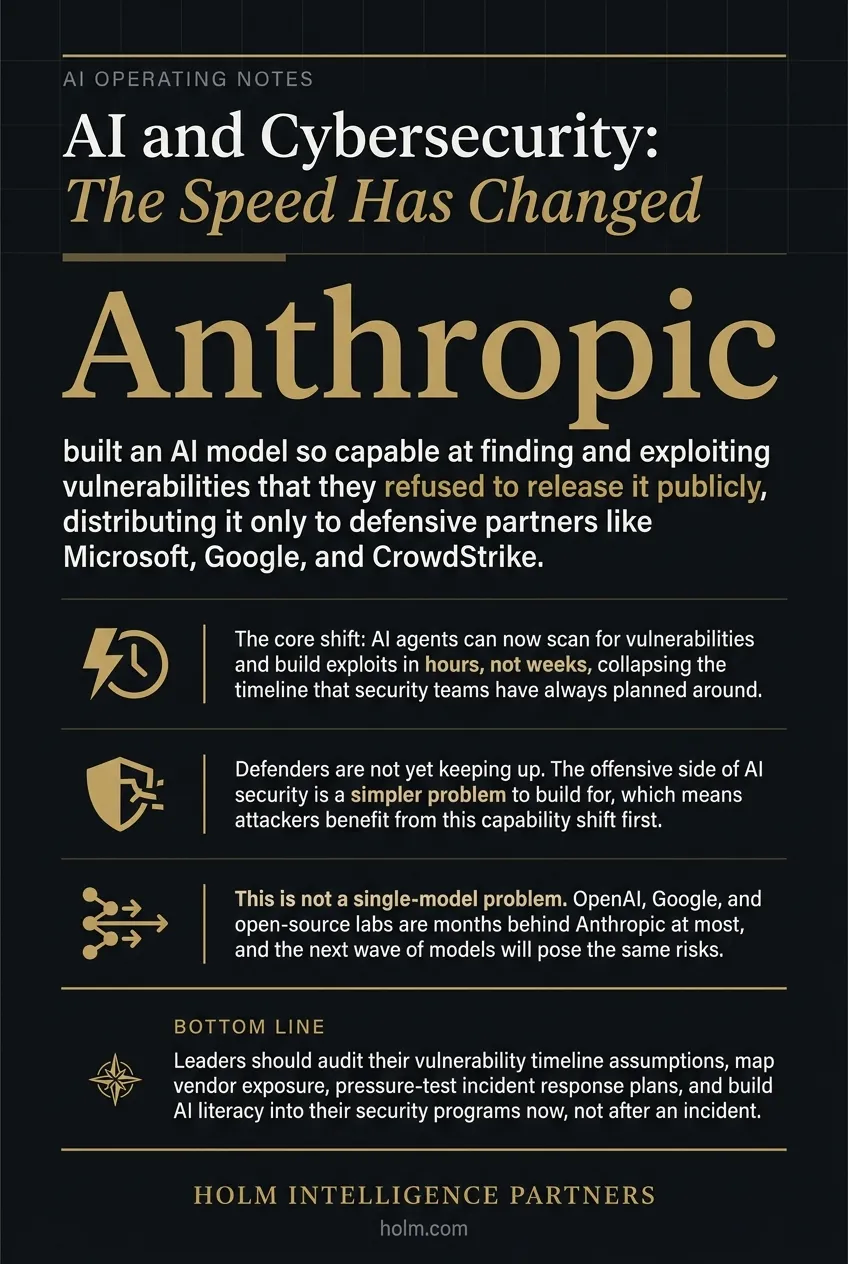
- Anthropic built an AI model so capable at finding and exploiting vulnerabilities that they refused to release it publicly, distributing it only to defensive partners like Microsoft, Google, and CrowdStrike.
- The core shift: AI agents can now scan for vulnerabilities and build exploits in hours, not weeks, collapsing the timeline that security teams have always planned around.
- Defenders are not yet keeping up. The offensive side of AI security is a simpler problem to build for, which means attackers benefit from this capability shift first.
- This is not a single-model problem. OpenAI, Google, and open-source labs are months behind Anthropic at most, and the next wave of models will pose the same risks.
- Leaders should audit their vulnerability timeline assumptions, map vendor exposure, pressure-test incident response plans, and build AI literacy into their security programs now, not after an incident.
The Cybersecurity Arms Race Just Changed Speed
Anthropic won't release its most capable AI model to the public. That alone should tell you something.
Claude Mythos Preview is being handed to Amazon, Apple, Cisco, Google, JPMorgan Chase, Microsoft, and a handful of other firms for one specific reason: find and fix software vulnerabilities before attackers do. Anthropic says the model has already found thousands of previously unknown software flaws in recent weeks, at a rate that far outpaces human researchers.
That's the defensive side. The offensive side is why they won't release it broadly.
"We did not feel comfortable releasing this generally," Logan Graham, who heads the team responsible for Anthropic's AI model defenses, told CNN. "We think that there's a long way to go to have the appropriate safeguards."
I've watched cybersecurity evolve through every major technology shift over the past 25 years. This one is different. Not because the threat is new, but because the speed is.
Why Does This Feel Different From Every Other AI Announcement?
Most AI product launches come wrapped in language about productivity and creativity. This one came with a government briefing.
Anthropic has briefed senior US officials across multiple agencies on Mythos' full offensive and defensive capabilities. They've also made themselves available to support the government's own testing and evaluation of the technology. That's not a product launch. That's a warning shot dressed up as a partnership.
What makes this substantively different from past cybersecurity advances? A single AI agent can now scan for vulnerabilities and potentially exploit them faster and more persistently than hundreds of human hackers working in parallel. That's not a marginal improvement. That's a category change in how attacks happen.
The old model of cybersecurity was a numbers game. Attackers had volume. Defenders had depth. Both sides were constrained by human speed. When you remove the human speed constraint from the attacker side, the entire equation breaks.
Anthropic knows this. A leaked blog post previewing Mythos' capabilities, first reported by Fortune, said the model "presages an upcoming wave of models that can exploit vulnerabilities in ways that far outpace the efforts of defenders." That's Anthropic describing its own model. Not a competitor. Not a critic. The company that built it.
Is Anthropic Actually Ahead, or Is This Just Marketing?
Fair question. Every AI lab claims their model is the best at something. But the structure of this release suggests something more grounded than typical product positioning.
They're not selling Mythos. They're restricting it. The recipients aren't customers. They're defensive partners: CrowdStrike, Palo Alto Networks, Broadcom, Nvidia, the Linux Foundation. These are organizations responsible for infrastructure that billions of people depend on every day. If this were marketing, you'd see a waitlist and a pricing page. Instead, you see a controlled distribution to firms that maintain operating systems, browsers, chips, and security platforms used at global scale.
Does that mean Anthropic's claims about finding thousands of vulnerabilities are verified? No. CNN noted they couldn't immediately verify that figure. But the approach itself, restricting release and briefing government officials, is consistent with a company that believes it's holding something genuinely dangerous.
The more important point isn't whether Mythos is the best model today. It's what comes next.
As cybersecurity researcher Adam Kramer pointed out: "Behind Mythos is the next OpenAI model, and the next Google Gemini, and a few months behind them are the open-source Chinese models." OpenAI already warned in December that its upcoming models posed a "high" cybersecurity risk.
This isn't about one model. It's about a capability threshold that multiple labs are crossing at roughly the same time.
What Does This Actually Mean for Companies?
If you're running a business, here's the practical reality: the window between a vulnerability existing and a vulnerability being exploited is about to collapse.
Historically, when a security researcher found a flaw in software, there was a disclosure process. The vendor got notified. A patch was developed. It rolled out. That timeline was measured in weeks or months. Attackers who discovered the same flaw independently had a similar timeline for building an exploit.
AI agents change that timeline from weeks to hours. Maybe minutes.
This matters most for companies in a few specific categories.
Companies that build software. If your product has users, your code now faces a different class of scrutiny. AI models can scan codebases for patterns that indicate vulnerabilities with a thoroughness no human team can match. The bugs that used to hide in complexity won't hide anymore.
Companies that depend on software. Which is everyone. Your exposure is determined by how fast your vendors find and fix their own flaws. The vendors on Anthropic's early access list are being given tools to do that faster. Everyone else is waiting.
Companies in regulated industries. Financial services, healthcare, critical infrastructure. These sectors already face compliance pressure around cybersecurity. When the capability of AI-driven attacks becomes well-documented, regulatory expectations will shift. "We followed proven methods" won't hold up when those proven methods were designed for human-speed threats.
Is the Defender Side Actually Keeping Up?
Not yet. That's the uncomfortable truth at the center of this story.
Gadi Evron, founder of AI security firm Knostic, put it plainly: "Unlike attackers, defenders don't yet have AI capabilities accelerating them to the same degree."
This asymmetry isn't new. Attackers have always had structural advantages. They only need to find one way in. Defenders need to protect everything. AI amplifies that asymmetry because offensive applications are simpler to build. Finding a flaw is a more constrained problem than securing an entire system.
Evron also made a point that often gets lost in the fear. Attack capabilities are available to both sides, and defenders must use them if they're to keep up. Security researchers have been using AI for defense long before Mythos arrived. In December, Evron and other researchers released a tool based on Anthropic's Claude model to generate fixes for severe software vulnerabilities.
The tools exist. The question is adoption speed.
I see this pattern constantly in the work we do at Holm Intelligence Partners. Companies know the shift is happening. They can describe it in meetings. But the gap between understanding a change and operationally responding to it is where most organizations stall. The companies that move fastest aren't necessarily the ones with the biggest budgets. They're the ones with the clearest picture of where they're actually exposed.
What Should Leaders Be Doing Right Now?
Not panicking. But not waiting either.
Here's what I'd tell any executive or board member processing this news.
First, audit your assumptions about vulnerability timelines. If your security posture assumes weeks between discovery and exploitation, that assumption is becoming dangerous. Talk to your security team about what changes if that window shrinks to days.
Second, understand your vendor exposure. Which of your critical software providers are on Anthropic's early access list? Which aren't? This isn't about brand loyalty. It's about knowing which parts of your stack are getting AI-powered vulnerability scanning and which parts are still relying on traditional methods.
Third, pressure-test your incident response plan. Not the document. The actual capability. If an AI-discovered vulnerability in a tool you depend on gets exploited before a patch is available, what happens? Who decides what? How fast can you isolate affected systems? Most incident response plans were written for a slower threat environment.
Fourth, build internal AI literacy around security. This doesn't mean hiring a team of AI researchers. It means making sure your security leaders understand what AI-powered threat detection looks like, what it costs, and what it requires. Companies that treat AI security as a separate initiative from their core security program will find themselves perpetually behind.
This is the kind of operational shift we help companies think through in our AI Operating Review. Not the theoretical risk. The practical question of what changes in your business when the threat environment moves at machine speed.
Is Anthropic's Approach the Right One?
I think the instinct is correct, even if the execution will be imperfect.
Restricting a powerful model and distributing it to defensive partners is a better approach than either extreme: releasing it publicly and hoping for the best, or locking it away entirely while attackers build their own versions. But there's a tension here that Anthropic can't resolve alone. They're one lab. Mythos is one model.
As Kramer noted, every major lab's next model will pose increasingly severe cybersecurity threats. A controlled release from one company doesn't solve the problem when open-source alternatives from other countries are months behind.
The real question isn't whether Anthropic handled this well. It's whether the broader industry, including governments, can coordinate fast enough to keep defensive capabilities in line with offensive ones.
History suggests they can't. Not because people aren't trying, but because coordination is slow and capability development is fast. That gap is the actual risk.
Where Does This Leave Us?
In a transition that most companies haven't fully internalized yet.
The cybersecurity environment has been shifting toward AI-driven threats for a while. Mythos is just the moment where a major lab said it out loud and acted so.
Logan Graham's framing is worth sitting with: "If models are going to be this good, and probably much better than this, at all cybersecurity tasks, we need to prepare pretty fast. The world is very different now if these model capabilities are going to be in our lives."
He's right. "Prepare pretty fast" is the operative phrase.
The companies that treat this as a news cycle will read the headline, note it, and move on. The companies that treat it as an operational signal will start asking hard questions about their security posture, their vendor dependencies, and their readiness for a threat environment that moves at a speed they haven't planned for.
I've seen enough technology shifts to know the difference between hype and a real inflection point. The hype is in the breathless coverage. The inflection point is in the restricted release, the government briefings, and the quiet acknowledgment from the people who built the thing that they don't think the world is ready for it.
That's not marketing. That's a signal. Act on it.
Infographic
Frequently Asked Questions
- What is Anthropic Claude Mythos and why isn't it being released publicly?
- Claude Mythos Preview is Anthropic's most capable AI model for cybersecurity tasks. It can find and exploit software vulnerabilities faster than human researchers by a wide margin. Anthropic chose not to release it publicly because the offensive capabilities are too powerful without adequate safeguards in place. Instead, it's going to a controlled group of defensive partners.
- How does AI change the timeline for cyberattacks?
- The old timeline ran weeks to months: a flaw gets found, disclosed, patched, and deployed. AI agents compress that to hours, possibly minutes. If an attacker is using AI to scan for vulnerabilities and build exploits, the window between a flaw existing and a flaw being used against you shrinks dramatically.
- Are defenders keeping up with AI-powered cyber threats?
- Not yet. Attackers have a structural advantage because finding a flaw is a more constrained problem than securing an entire system. AI amplifies that gap. Security researchers are using AI for defense, and the tools exist, but adoption speed is the real question. Most organizations are still running security programs designed for human-speed threats.
- Which companies got access to Claude Mythos Preview?
- Anthropic gave access to Amazon, Apple, Cisco, Google, JPMorgan Chase, Microsoft, CrowdStrike, Palo Alto Networks, Broadcom, Nvidia, and the Linux Foundation. These are organizations that maintain infrastructure billions of people depend on daily.
- What should executives do right now in response to AI-driven cybersecurity threats?
- Four things: audit your assumptions about vulnerability timelines, understand which of your critical vendors are getting AI-powered scanning tools and which aren't, pressure-test your actual incident response capability (not just the document), and make sure your security leaders understand what AI-powered threat detection requires. Start those conversations before an incident forces them.
- Is this just one company's problem or an industry-wide shift?
- It's industry-wide. OpenAI flagged its upcoming models as high cybersecurity risk in December. Google's next Gemini models will face the same scrutiny. Open-source Chinese models are months behind. Anthropic's restricted release is a responsible move, but it doesn't solve the problem when multiple labs are crossing the same capability threshold at roughly the same time.