AI Didn't Fail at Your Company. It Fragmented.
Key Takeaways
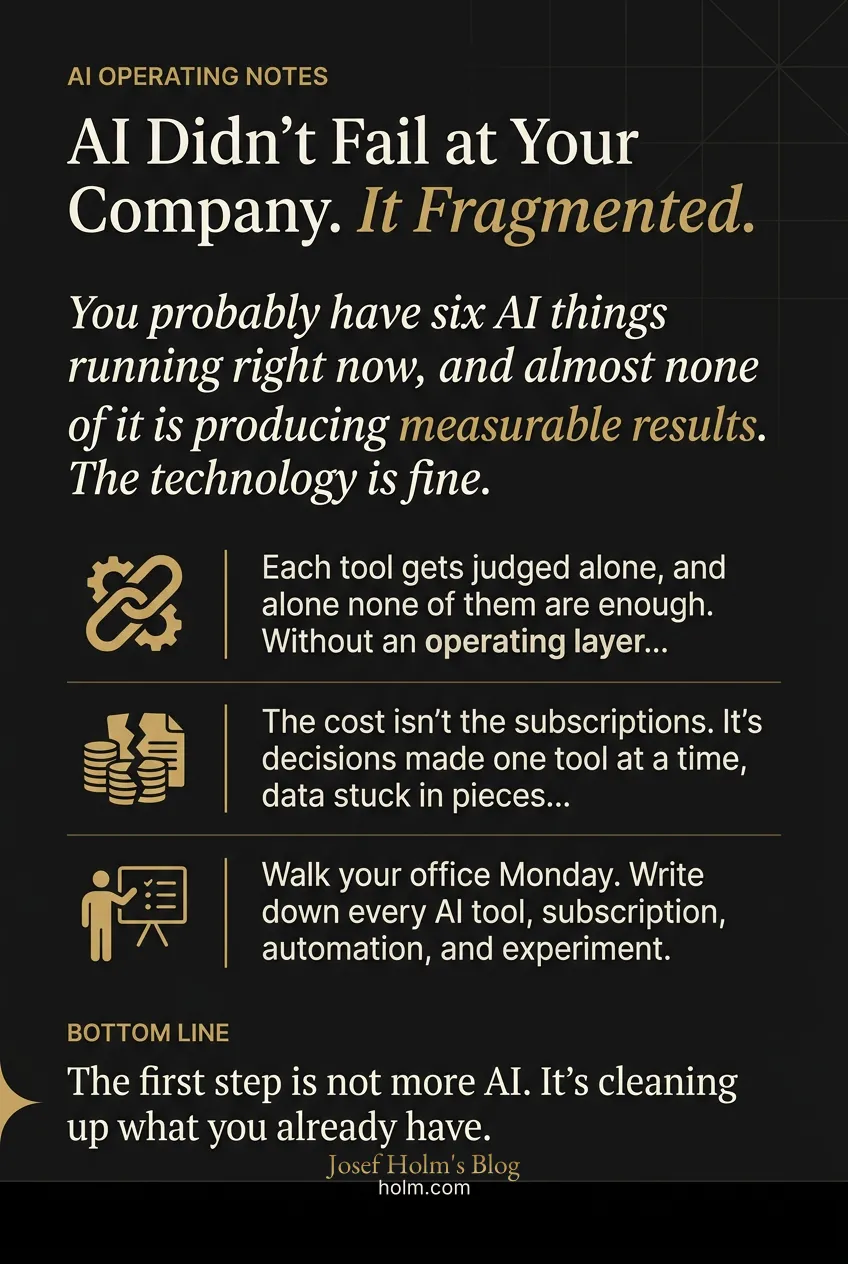
- You probably have six AI things running right now, and almost none of it is producing measurable results. The technology is fine. The decisions are missing.
- Each tool gets judged alone, and alone none of them are enough. Without an operating layer above the tools, every tool becomes a political debate instead of an operational one.
- The cost isn't the subscriptions. It's decisions made one tool at a time, data stuck in pieces, and CEOs burning quarters arguing about whether a chatbot should stay or go.
- Walk your office Monday. Write down every AI tool, subscription, automation, and experiment. Ask what decision it helps make, who owns the outcome, and what breaks if you kill it.
- The first step is not more AI. It's cleaning up what you already have.
If you run a mid-market business and you've ever said "we tried AI and it didn't work," hold that sentence up against what's actually running inside your company right now.
You probably have six AI things going. Maybe more.
A chatbot your website vendor sold you. A ChatGPT subscription the team passes around. AI features baked into software you already pay for. An automation someone built six months ago that nobody maintains. A tool that got bought and shelved. An experiment somebody ran in their spare time and never told you about.
Almost none of it is producing measurable results.
That's not a story about your company. It's the pattern everywhere. Researchers have a name for it now: AI Fragmentation. MIT, Gartner, and the AI engineering community have measured it. Somewhere between 75 and 95 percent of AI efforts fail to deliver.
The technology is fine. The decisions are missing.
Nobody in your company owns what to keep, what to fix, what to kill, and what to do next. So nothing compounds. You don't have an AI problem. You have six of them. And nobody has decided which one matters.
Why does scattered AI feel like failure when the tools mostly work?
Because each tool gets judged alone, and alone, none of them are enough.
Your website chatbot handles some inquiries. Fine. Your shared ChatGPT writes faster drafts. Fine. AI features in your CRM auto-tag some records. Also fine. Individually, each one does something. Together, they don't add up to a capability. They add up to a tab graveyard.
This is where people get it wrong. They think the problem is tool selection. It isn't. The problem is that there's no operating layer sitting above the tools deciding what the company is actually trying to do with AI.
Without that layer, every tool becomes a debate. Should we keep the chatbot? Is ChatGPT worth the seats? Did that automation ever pay for itself? Those debates have no answer because nobody set the criteria for what "working" means.
So the tools stay. The debates stay. Nothing compounds. And the CEO walks away thinking AI didn't work.
What is AI Fragmentation actually costing you?
It's not the subscriptions. Those are rounding errors. The real cost sits in a few places.
Decisions get made one tool at a time. Whoever bought it defends it. Whoever didn't want it attacks it. There's no shared standard. So every tool becomes a political fight instead of an operational one.
Your data stays in pieces. The chatbot has its own conversation log. The CRM has its automation history. The shared ChatGPT account forgets everything between sessions. Six tools running. Zero institutional memory. Every new AI effort starts from scratch because the last one left nothing behind worth building on.
Your most expensive resource is getting burned on low-stakes debates. I've watched CEOs spend an entire quarter arguing about whether the website chatbot should stay or go. The chatbot was never the problem. The absence of a decision layer was. That quarter is gone. The chatbot is still there. Nothing got decided.
The pattern I see inside mid-market companies, especially in the $10 to $100 million range, is consistent. Smart operators. Real budgets. Willing teams. And an AI footprint that looks like someone let six different vendors decorate the same house.
Why does this happen to good operators?
Because AI got sold to mid-market companies the same way SaaS did in 2014. Tool by tool. Department by department. Whoever made the case first got the budget.
That worked for SaaS because each tool solved a bounded problem. Email marketing. Expense reporting. Scheduling. You could stack them and mostly they'd stay out of each other's way.
AI doesn't work like that. It compounds when it shares context, data, and decisions. It fragments when it doesn't. And nobody warned the mid-market CEO that the SaaS playbook would produce a mess when applied to AI.
That's the real issue. It's not that your team bought bad tools. They bought tools the way everyone's been trained to buy software, and AI punishes that pattern harder than SaaS ever did.
I've seen this cycle before. It looks a lot like the early cloud migration years, where companies ended up with seven overlapping cloud accounts and no cost visibility. The fix then wasn't more cloud. It was a layer above the cloud. Same shape here.
What does a CEO actually do about it on Monday?
Start with a walk. I'm serious.
Walk your office on Monday. Write down every AI tool, subscription, automation, and experiment currently running in your business. Include the things you bought and shelved. Include the ones nobody else knows about but someone on your team is quietly using. Include the AI features embedded inside tools you think of as "not AI tools."
Most CEOs I run this exercise with stop counting somewhere between eleven and twenty items.
Writing the list won't solve fragmentation by itself. But you can't decide what to keep, fix, or kill without it. The list is the first move, and it's not optional.
Then ask three questions about each item:
- What decision does this tool help us make faster or better?
- Who owns the outcome it's supposed to produce?
- If we turned it off tomorrow, would anything measurable get worse?
Can't answer those three for an item on the list? You've found something to kill. Not something to debate. Something to kill.
That's the work. It's not glamorous. It's not an AI strategy deck. It's just the honest inventory most mid-market companies have never done.
Why this matters now
The companies that will pull ahead over the next 24 months aren't the ones buying more AI. They're the ones who cleaned up what they already had and built a decision layer above it.
That's the thesis behind what we do at Josef Holm. Not more tools. A clearer operating layer. If you want to see what that looks like in practice, the AI readiness note is where most of our client relationships start. It's the walk-the-office exercise, done formally, with a decision framework attached.
You don't need us to start, though. You need a notebook and a Monday morning.
The first step is not more AI. It's cleaning up what you already have.
Josef
Infographic
Frequently Asked Questions
- What is AI fragmentation?
- AI fragmentation is what happens when a company ends up with six or more separate AI tools, subscriptions, and experiments running in parallel, none of them sharing data, context, or a common owner. Each tool works fine alone. Together they produce no compounding value. MIT and Gartner have measured it: 75 to 95 percent of AI efforts fail to deliver, and fragmentation is the main reason.
- Why do most AI initiatives fail at mid-market companies?
- The tools aren't the problem. The missing decision layer is. Most mid-market companies bought AI the same way they bought SaaS in 2014: tool by tool, department by department. AI punishes that pattern because it compounds only when context, data, and decisions are shared. Without someone owning what to keep, fix, and kill, nothing compounds and every tool becomes a political debate.
- How do I audit the AI already running in my company?
- Walk the office. Write down every AI tool, subscription, automation, embedded AI feature, and informal experiment. Include the shelved stuff. Then ask three questions about each item: what decision does this help us make faster or better, who owns the outcome, and if we turned it off tomorrow would anything measurable get worse. If you can't answer those three, kill it.
- What is the real cost of AI fragmentation?
- It's not subscriptions. The real cost shows up in three places: decisions get made one tool at a time with no shared standard, your data stays in pieces so every new effort starts from scratch, and your most expensive resource (CEO and leadership time) gets burned on low-stakes debates about individual tools instead of operational questions.
- What is an AI decision layer?
- A decision layer is the operating standard that sits above your AI tools and defines what the company is trying to do with AI, what counts as working, and who owns each outcome. Without it, every tool becomes a debate with no answer. With it, you can decide which tools compound, which get fixed, and which get killed, without it turning political.
- Should mid-market CEOs buy more AI tools in 2025?
- No. The companies that pull ahead over the next 24 months are the ones who clean up what they already bought and build a decision layer above it. More tools on top of a fragmented stack makes the mess worse. Start with the inventory. Cut what doesn't produce a measurable outcome. Then decide what to add.