Your AI Prompt Library Is Already a Museum Piece
Key Takeaways
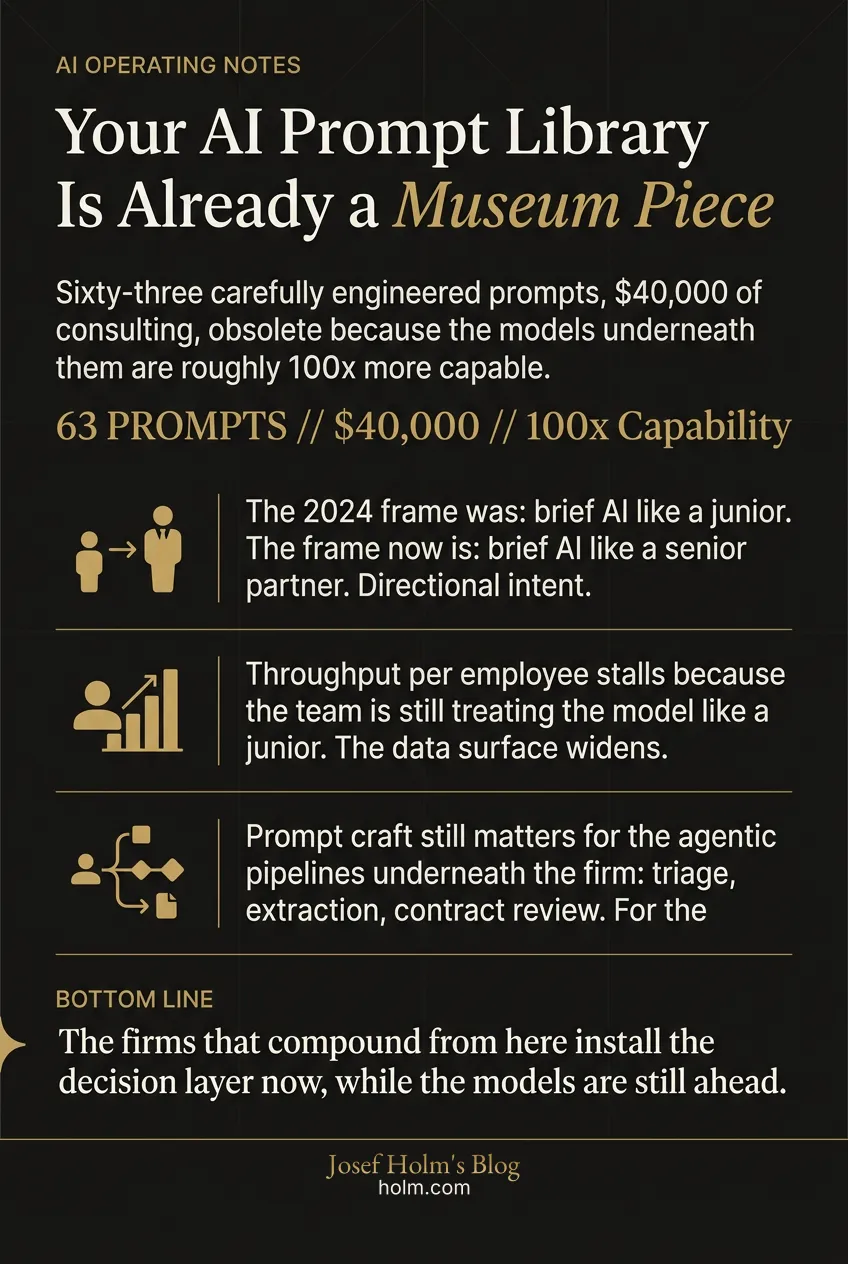
- Sixty-three carefully engineered prompts, $40,000 of consulting, obsolete because the models underneath them are roughly 100x more capable than they were 14 months ago.
- The 2024 frame was: brief AI like a junior. The frame now is: brief AI like a senior partner. Directional intent, questions about what good looks like, data plus opinion anchored together.
- Throughput per employee stalls because the team is still treating the model like a junior. The data surface widens because the more capable the model gets, the more context people feed it without anyone deciding what belongs there.
- Prompt craft still matters for the agentic pipelines underneath the firm: triage, extraction, contract review. For the heavy exec work, the differentiating skill has moved.
- The firms that compound from here install the decision layer now, while the models are still ahead of the practice. The ones that wait will spend 2026 trying to catch up to where their competitors got in Q1.
The Prompt Engineering Era Is Over. Most Mid-Market Firms Never Noticed.
A COO at a mid-market firm forwarded me her team's "AI prompt library" last month. Sixty-three carefully engineered prompts. Variable placeholders, persona instructions, the kind of artifact a consultant produced for $40,000 in early 2024.
It's already obsolete.
Not because the prompts are bad. Because the models underneath them are now roughly 100x more capable than they were when those prompts got written. Claude's Opus tier and OpenAI's frontier releases this quarter have changed the work itself. The prompt library is solving a problem that no longer exists, while the actual problem (how senior people brief AI on complex work) hasn't been touched.
This is what AI Fragmentation looks like when nobody is watching. Not too few tools. Tools used at the wrong altitude, with practices that froze 14 months ago.
Why does your prompt library feel stale?
Because the model you're prompting changed underneath it.
The frontier model that arrived this quarter doesn't need to be told to "think step by step" or "act as a senior consultant with 20 years of experience." It already does. It can call tools, hold a working context across an entire engagement, and synthesise across data you barely organised. The careful instruction-stacking that defined prompt engineering in 2024 is now table stakes at best, and patronising overhead at worst.
The frame that worked last year was: brief AI like a junior. Be precise, constrain the task, check the output. The frame that works now is different. Brief AI like a senior partner. Convey intent, supply context, invite pushback, hold the bar on synthesis.
Most firms haven't made that shift because nobody at the firm has the authority to make it. Marketing wrote their prompts. Finance wrote theirs. Operations wrote theirs. Nobody owns the practice across the firm, and the IT team that was supposed to be the adult in the room is busy provisioning Copilot licences.
What does "senior partner" actually mean in operating terms?
Three things, and none of them are about prompt syntax.
One: directional intent, not task specification. A good manager handing off to a senior doesn't say "produce a five-slide deck with these bullets." They say "I have a thesis that our customer acquisition cost has decoupled from our product margin, and the last three launches are evidence. Investigate." That sentence has a centre and a perimeter. The AI now knows where to focus and where it's allowed to wander.
Two: questions about what "good" looks like. When the output is open-ended (a strategy memo, a customer narrative, a board pre-read), the work isn't to dictate structure. It's to force the model to wrestle with the dimensions of quality. How does this read to a sceptical board member? Where does the argument get weakest? What does an LP ask after page two? Layered questions, not flat instructions.
Three: data plus opinion, anchored together. Drop the model into a folder of formal artifacts (P&Ls, PRDs, contracts) and informal ones (meeting transcripts, customer interview notes, Slack threads). Then frame the question so the model engages with the breadth, not the first file it latched onto. State your thesis. Tell it you might be wrong. Demand the cleanest, most explanatory synthesis across everything.
That's closer to how a real exec briefs a real consultant than anything the prompt-engineering era produced.
So is prompt engineering dead?
No. It's demoted.
Prompt craft still matters for the agentic pipelines running underneath the firm: the customer service triage, the invoice extraction, the contract review queue. Those need precision, evals, version control, the whole discipline. Most firms haven't built those properly either, which is a separate problem worth its own audit.
But for the heavy knowledge work, the stuff your exec team actually spends time on, the differentiating skill has moved. It's no longer "can you write a great prompt." It's "can you brief an agent like you'd brief a senior partner who's smarter than most of your team."
That skill is not evenly distributed. Some of your people already have it, because they were good managers before AI showed up. Some of your people will never develop it, because they were never good managers in the first place. The AI doesn't fix that gap. It exposes it.
Where does this leave the mid-market CEO?
In an uncomfortable position, if they're paying attention.
The firm is already running AI everywhere. Shadow AI across functions. Sixty-three prompts in a library nobody updates. Copilot licences nobody audits. A "ChatGPT Enterprise" rollout that produced two months of enthusiasm and zero margin movement. And underneath all of it, frontier models that have just become capable of doing work the firm has no practice for capturing.
This is the part the vendor decks don't show. The gap between what the models can do and what your firm can ask them to do is now the entire game. The tooling isn't the constraint. The briefing practice is. And the briefing practice is a leadership problem, not an IT problem.
The cost of getting this wrong shows up in two places at once. Throughput per employee stalls, because the team is still treating the model like a junior and getting junior output. And the data surface widens, because the more capable the model gets, the more context people feed it (transcripts, PRDs, customer files, financials) without anyone deciding what should and shouldn't sit in that context window. Throughput compresses on one side, exposure compounds on the other, and the firm doesn't see either until something forces it to.
What would you even ask for?
This is where most leadership teams stall. They know the prompt library is stale. They know Shadow AI is everywhere. They know the new models are more capable than their practice. They don't know what to do about it.
The instinct is to hire a head of AI, buy a platform, or run a workshop. None of those fix the underlying problem, which is that the firm has no decision layer for what AI work gets done, by whom, with what data, against what standard. Without that, the next sixty-three prompts will be just as stale in nine months.
The fix is narrower than people expect. It starts with a workflow-by-workflow read of where AI is actually being used in the firm right now, what it's producing, what it's costing, and what it's exposing. Then a verdict on each one: kill it, fix it, or build the next version properly. Then a thin governance line that says: this is the AI we keep, these are the data classes that flow into it, this is who briefs it, this is the standard the output has to hit.
That's the AI readiness note. Not a strategy deck. A prioritised remediation roadmap that compounds throughput inside an enforced governance line. The Opportunity Map names the workflows. The Kill, Fix, Build verdict makes the calls. The senior-partner briefing practice gets installed where the work actually happens, not in a prompt library nobody reads.
What's the actual next step?
If your prompt library was written more than six months ago, it's a museum piece. If your team is still treating frontier models like a slightly faster intern, you are leaving the entire margin opportunity of this cycle on the table. And if nobody at the firm owns the briefing practice across functions, you don't have an AI strategy. You have AI Fragmentation with better PR.
The firms that compound from here are the ones that install the decision layer now, while the models are still ahead of the practice. The ones that wait will spend 2026 trying to catch up to where their competitors got in Q1.
Infographic
Frequently Asked Questions
- Is prompt engineering dead?
- No. It's demoted. Prompt craft still matters for the agentic pipelines running underneath the firm, like customer service triage, invoice extraction, and contract review queues. Those need precision, evals, and version control. But for the heavy knowledge work your exec team actually spends time on, the differentiating skill is no longer writing a great prompt. It's briefing an agent like a senior partner.
- Why does my AI prompt library feel stale?
- Because the model you're prompting changed underneath it. The frontier model that arrived this quarter doesn't need to be told to think step by step or act as a senior consultant. It already does. The instruction-stacking that defined prompt engineering in 2024 is table stakes at best, patronising overhead at worst.
- What does briefing AI like a senior partner mean in practice?
- Three things. Directional intent rather than task specification: convey the thesis and the perimeter, let the model investigate. Questions about what good looks like: force the model to wrestle with quality dimensions, not flat instructions. Data plus opinion anchored together: drop in formal and informal artifacts, state your thesis, demand synthesis across all of it.
- Why hasn't my firm made this shift?
- Because nobody has the authority to make it. Marketing wrote their prompts. Finance wrote theirs. Operations wrote theirs. Nobody owns the practice across the firm, and IT is busy provisioning Copilot licences. The briefing practice is a leadership problem, not an IT problem.
- What's the cost of getting this wrong?
- It shows up in two places at once. Throughput per employee stalls, because the team is still treating the model like a junior and getting junior output. And the data surface widens, because the more capable the model gets, the more context people feed it without anyone deciding what should and shouldn't sit in that context window.
- What's the actual next step?
- A workflow-by-workflow read of where AI is actually being used in the firm, what it's producing, what it's costing, and what it's exposing. Then a verdict on each one: kill it, fix it, or build the next version properly. Then a thin governance line that names the AI you keep, the data classes that flow into it, who briefs it, and the standard the output has to hit. That's the AI readiness note.