The UAE Agentic AI Mandate Has a 24-Month Clock
Key Takeaways
- A Managing Director of a $40M Dubai distribution business told me last month his firm was doing AI: three Copilot licences, a ChatGPT Teams account, a custom GPT, two SaaS pilots finance never saw. He thought he was ahead. He is on the wrong side of a federal directive with under twenty-four months on the clock.
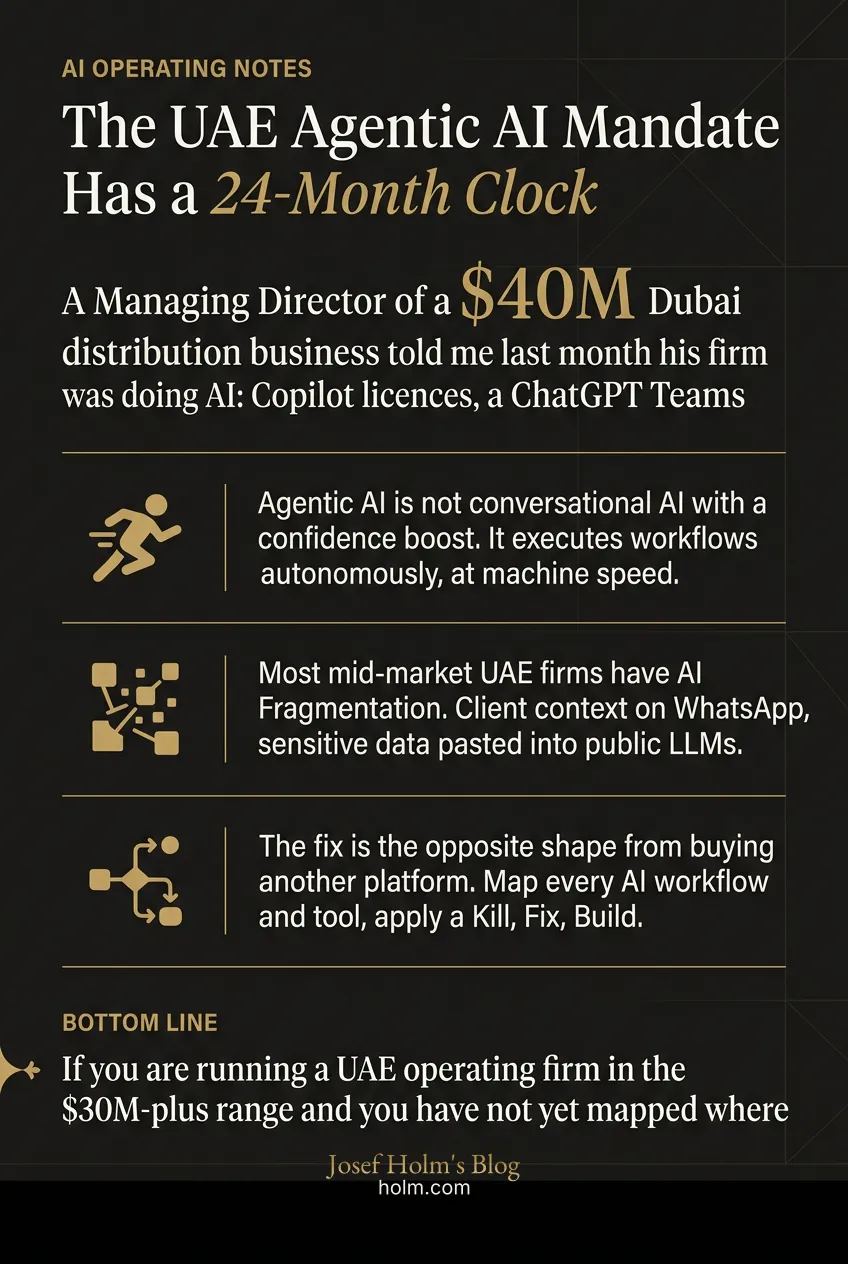
- Agentic AI is not conversational AI with a confidence boost. It executes workflows autonomously, at machine speed, across enterprise systems. That capability has one hard prerequisite: a clean, governed, sovereign data layer underneath it.
- Most mid-market UAE firms have AI Fragmentation. Client context on WhatsApp, sensitive data pasted into public LLMs, Shadow AI licences nobody approved. An autonomous compliance agent cannot file a DFSA report if the inputs live on a sales executive's personal phone. PDPL fines run AED 50,000 to AED 5 million.
- The fix is the opposite shape from buying another platform. Map every AI workflow and tool, apply a Kill, Fix, Build verdict, then build only what the firm actually needs. The AI readiness note produces the Opportunity Map in three weeks.
- If you are running a UAE operating firm in the $30M-plus range and you have not yet mapped where your AI Fragmentation actually lives, the Audit is the place to start.
The mandate landed in April. Most mid-market firms in the UAE still think they have time.
A Managing Director of a $40M Dubai distribution business told me last month his firm was "doing AI." Three Copilot licences, a ChatGPT Teams account, a custom GPT his marketing lead built, plus two SaaS pilots his ops director signed up for without telling finance. He thought he was ahead.
He's not. He's on the wrong side of a federal directive, and the clock to fix it is now under twenty-four months.
On 23 April 2026, the UAE federal government mandated that 50 percent of all federal services transition to Agentic AI by April 2028. Eleven days later, Crown Prince Sheikh Hamdan extended the same deadline to the entire Dubai private sector, with the Dubai Chamber of Commerce administering compliance through training tracks, incubators, and dedicated investment funds. On 21 May, the UAE Cyber Security Council, e&, and Open Innovation AI launched the Sovereign AI Platform, setting the security and data-sovereignty floor every autonomous agent in the country must clear.
This is not a strategy paper. It's industrial policy with a deadline.
What the mandate actually requires (and what most operators are misreading)
Most owner-operators I speak to read "Agentic AI by 2028" as a software-procurement exercise. Buy the agents, deploy them, tick the box. That reading is wrong, and it's wrong in a way that will cost them the next two years.
Agentic AI is not conversational AI with a confidence boost. Conversational AI answers questions. Agentic AI executes workflows. It places the procurement order. It files the tax return. It onboards the client. All of this happens autonomously, at machine speed, across multiple enterprise systems, without a human pressing confirm on every step.
That capability has one hard prerequisite: a clean, governed, sovereign data layer underneath it. The UAE Cabinet acknowledged this implicitly when it passed the "government services digital records policy" on the same day as the federal Agentic AI directive. Before you deploy autonomous agents, you build the single source of truth they execute against. Federal government did this for itself in one motion. Private sector got the same two-year clock and no roadmap.
Which leaves one question: what does the underlying data architecture in a typical mid-market UAE firm actually look like, and how far is it from what the mandate assumes?
The fragmentation gap nobody is naming
Here is what I see when I walk into a $30M-plus UAE operating firm. Client context lives on WhatsApp, on personal phones, encrypted, undiscoverable. Roughly 80 percent of the UAE population uses WhatsApp; the de facto operating system for client management, vendor negotiation, and internal decisions is a consumer messaging app sitting outside every governance perimeter the firm has.
Foundational AI tools get used with no proprietary data layer underneath them. An employee pastes sensitive client information into a public LLM to draft a proposal. The model has no context, hallucinates, and the data is gone into a training corpus the firm has zero control over.
The IT budget is bleeding into what I call Shadow AI: unmanaged Copilot licences, ChatGPT Teams seats nobody approved, departmental SaaS pilots signed by marketing or HR without finance or IT in the room. Where a DPO exists, they cannot govern systems they don't know exist.
This is AI Fragmentation. The diagnosed condition of nearly every mid-market firm in the UAE today, and it makes compliance with the 2028 mandate technically impossible.
An autonomous procurement agent cannot negotiate a contract if the context lives in an encrypted WhatsApp thread on a sales executive's personal phone. An autonomous compliance agent cannot file a DFSA report if the relevant communications are scattered across unmanaged channels the firm cannot even discover. An autonomous client-onboarding agent cannot honour a PDPL erasure request if the client's PII is sitting in three departmental SaaS tools nobody mapped.
What this costs in regulatory exposure, not just throughput
The throughput cost is obvious. Agents that execute on incomplete data produce flawed decisions at machine speed. Broken contracts, mis-priced orders, rejected government bids, regulator inquiries, all happening faster than human supervisors can catch them.
Regulatory cost is the part most operators are not in yet.
Under the UAE Personal Data Protection Law (Federal Decree-Law No. 45 of 2021), data subjects have the right to access, rectify, and erase their personal data. If the data is fragmented across WhatsApp threads and unmanaged SaaS tools, the firm cannot honour the request. Fines run to AED 5 million. Article 9 mandates immediate breach reporting; a breach on a decentralised WhatsApp network is not even detectable, let alone reportable. Article 432 of the Penal Code adds criminal liability for unauthorised disclosure by virtue of profession.
For DFSA-regulated firms inside DIFC, the exposure escalates. The Conduct of Business Rulebook mandates electronic communication retention. March 2025 rulebook updates strengthened AML, CTF, and CPF requirements. Recent enforcement is not theoretical: Ark Capital Management was fined $504,000 for failing to detect and report ten suspicious trades. Baker Tilly MKM and Ed Broking faced their own penalties for inadequate systems and controls.
Now layer Agentic AI on top of that fragmented architecture. The agent generates an autonomous compliance report. Auditor asks for the data trail. The firm cannot produce it because the inputs lived on a sales executive's personal device. The defence is not "the agent made a mistake." The defence does not exist.
Throughput and data sovereignty are not two problems. One problem, one operating fix.
So what does the fix actually look like?
The reflex answer from most consultancies right now is the standard one: buy an enterprise AI platform, run a change programme, build an internal AI centre of excellence, hire a Chief AI Officer. Big budget, multi-year, vendor-led.
Wrong answer, and the evidence above tells you why. The problem is not that the firm lacks AI. The problem is that the firm has too much AI, deployed in too many places, on top of a data architecture that cannot support autonomous execution. Adding another platform on top of AI Fragmentation makes the fragmentation worse, not better.
The right answer is the opposite shape. Before you deploy a single autonomous agent, you map every AI workflow, tool, and pilot the firm is currently running, you cite the cost of each in throughput and exposure terms, and you apply a Kill, Fix, Build verdict to each one. Most of what mid-market firms are running today gets killed. A smaller set gets fixed and brought inside a governance line. A targeted set of new builds gets prioritised against the workflows where autonomous execution actually compounds margin.
This is the AI readiness note. Fixed scope, bounded, three weeks. It produces an Opportunity Map: a prioritised remediation roadmap covering every AI surface in the firm, every data-exposure point, every workflow ready for governed autonomous execution and every workflow that is not. Throughput and data sovereignty on the same page.
For firms that need ongoing principal-led oversight through the deployment phase, the operator note ongoing work is the firm equivalent of a AI leadership: the decision layer that sits between the operator and the autonomous systems, enforcing the governance line as agents come online.
The two-year clock starts now, not in 2027
The Dubai Chamber of Commerce is not a passive observer. It is administering training tracks, deploying capital through dedicated investment funds, and building incubators. Future commercial licensing, access to government-backed funding, and participation in premier business councils will be conditioned on demonstrated progress toward Agentic AI adoption. The federal government's own AI agents for procurement, tax auditing, customer service, and IT support are already deployed. By 2028, a big portion of B2G interaction in the UAE will be algorithm-to-algorithm.
A mid-market firm that arrives at May 2028 with WhatsApp silos, missing data layers, and a portfolio of Shadow AI tools will not just be non-compliant. It will be commercially incompatible with the economy it operates in. Its bids will be auto-rejected. Its tax filings will be flagged. Competitors will transact at machine speed while it transacts at human speed.
The work that needs to happen in the next twenty-four months is not deploying autonomous agents. It is fixing the data plumbing that autonomous agents will run on. That work has a sequence: map and kill what should not exist, fix and govern what should, build what the firm actually needs. In that order.
If you are running a UAE operating firm in the $30M-plus range and you have not yet mapped where your AI Fragmentation actually lives, the Audit is the place to start.
Infographic
Frequently Asked Questions
- What is the UAE Agentic AI mandate and when does it apply to private firms?
- On 23 April 2026, the UAE federal government mandated that 50 percent of federal services transition to Agentic AI by April 2028. Eleven days later, Sheikh Hamdan extended the same deadline to the entire Dubai private sector. The clock is under twenty-four months and the Dubai Chamber of Commerce is administering compliance.
- What is the difference between conversational AI and Agentic AI?
- Conversational AI answers questions. Agentic AI executes workflows. It places the procurement order, files the tax return, onboards the client, autonomously, at machine speed, across multiple enterprise systems, without a human pressing confirm on every step.
- Why does WhatsApp use create a compliance problem for UAE firms?
- Roughly 80 percent of the UAE population uses WhatsApp, and in most mid-market firms it is the de facto operating system for client management and internal decisions. That client context lives encrypted on personal phones, undiscoverable, outside every governance perimeter. An autonomous agent cannot execute against it, and a PDPL erasure request cannot be honoured against it.
- What are the regulatory penalties for AI Fragmentation under UAE law?
- PDPL fines run to AED 5 million. Article 9 mandates immediate breach reporting. Article 432 of the Penal Code adds criminal liability for unauthorised disclosure by profession. For DFSA-regulated firms, recent enforcement includes Ark Capital Management fined $504,000 for failing to detect and report ten suspicious trades.
- What is the right sequence for getting ready for the 2028 deadline?
- Map every AI workflow, tool, and pilot the firm is running. Cite the cost of each in throughput and exposure terms. Apply a Kill, Fix, Build verdict to each one. Most of what mid-market firms run today gets killed. A smaller set gets fixed and brought inside a governance line. A targeted set of new builds gets prioritised. In that order.
- What is the AI readiness note and what does it produce?
- Fixed scope, bounded, three weeks. It produces an Opportunity Map: a prioritised remediation roadmap covering every AI surface in the firm, every data-exposure point, every workflow ready for governed autonomous execution and every workflow that is not. Throughput and data sovereignty on the same page.