
The UAE Government is Buying Judgment. Why is the Private Sector Only Buying Software?
Key Takeaways
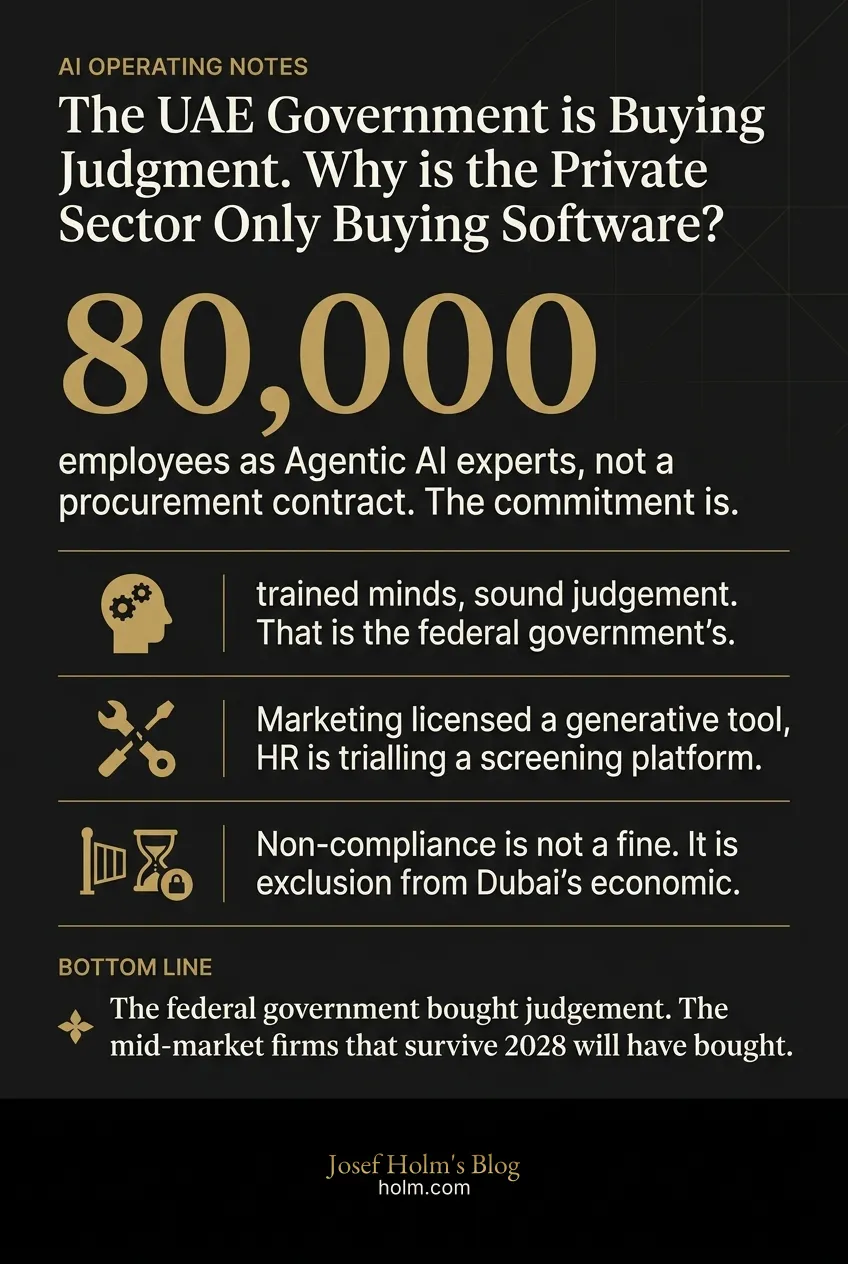
- The federal government signed a partnership to train 80,000 employees as Agentic AI experts, not a procurement contract. The commitment is to human competence, not tools.
- Khaldoon Al Mubarak named the foundation directly: trained minds, sound judgement. That is the federal government's stated foundation for Agentic AI, not the model and not the platform.
- The mid-market pattern is the opposite. Marketing licensed a generative tool, HR is trialling a screening platform, finance bought predictive analytics, legal pulled in contract review. Four vendors, four data lakes that do not speak to each other.
- The Dubai Chamber clock runs to May 2028. Non-compliance is not a fine. It is exclusion from Dubai's economic infrastructure.
- The federal government bought judgement. The mid-market firms that survive 2028 will have bought the same thing.
The federal government just signed a training deal for 80,000 employees. That's the headline. The signal underneath it is the one mid-market operators in Dubai and Abu Dhabi should be reading.
On 21 May 2026, the UAE Government announced a strategic knowledge partnership with MBZUAI to train 80,000 federal employees as Agentic AI experts. Executive tracks for senior leaders. Hands-on capability programmes across every occupational category. All of it pointed at the April 2028 deadline to move 50 percent of federal services and operations to Agentic AI.
The federal government is not buying tools. It is buying judgement.
That distinction is the whole story.
What did the UAE federal government actually commit to?
Read the partnership carefully and the shape becomes clear. This is not a procurement announcement. No vendor selection, no platform rollout, no programme tied to a brand. The commitment is to human competence.
Mohammad Abdullah Al Gergawi framed it directly. The training programmes are designed to "improve the capabilities of the federal workforce" and "strengthen institutional readiness." Khaldoon Al Mubarak said it plainer: "A government powered by AI is built on far more than the technologies it holds. Its success rests on human competence, trained minds, sound judgement."
Trained minds. Sound judgement.
That is the federal government's stated foundation for Agentic AI. Not the model. Not the platform. The people who decide what the agents do, what they touch, and what they don't.
Now hold that thought against what most mid-market firms are doing right now.
Why is the private sector running the opposite play?
In firm after firm I look at, the pattern is identical. Marketing licensed a generative tool. HR is trialling a screening platform. Finance bought predictive analytics. Legal pulled in a contract review tool. Four departments, four vendors, four data lakes that don't speak to each other.
Nobody trained anyone. Nobody set a decision layer. Nobody asked which tool stays, which one gets fixed, which one gets killed. The tools landed first; the judgement was supposed to follow. It rarely does.
This is the zombie pilots failure mode. F3 in the Josef Holm positioning shorthand. Unmanaged AI sprawl that looks like progress on the SaaS bill and reads like AI Fragmentation on the architecture diagram. The autonomous agent the federal government plans to deploy in 2028 needs cross-department data to function. The mid-market firm running four siloed pilots cannot deliver that. The agent hits a digital dead end on day one.
Then there is the Dubai Chamber clock. On 4 May 2026, HH Crown Prince Sheikh Hamdan bin Mohammed announced that Dubai's entire private sector transitions to Agentic AI by May 2028. Specialised training tracks through the Dubai Chamber of Commerce. Government-funded incubators. Dedicated investment funds. Future commercial licensing and council participation tied to demonstrated Agentic AI progress.
Non-compliance is not a fine. It is exclusion from Dubai's economic infrastructure.
What does the federal partnership tell mid-market operators to do differently?
This is where the MBZUAI announcement becomes a roadmap, not a press release.
The federal government's sequence is: train the people, then deploy the agents. The mid-market sequence in most firms I see is: deploy the tools, then hope someone figures out the rest.
Why does the federal sequence work? Because it puts the decision layer before the deployment layer. The mid-market sequence fails because it inverts that order. Tools without trained operators produce two outcomes: Shadow AI that nobody approved, or zombie pilots that nobody can prove ROI on. Often both at the same time.
The fix is not more tools. Fewer tools, governed by people who know which workflows to automate, which to leave alone, and which to kill outright. That is the work Josef Holm does inside the AI readiness note. Workflow by workflow. Kill, Fix, Build. The Opportunity Map at the end is the firm's equivalent of what the federal government just signed with MBZUAI: a structured view of where capability needs to be built, where existing investment needs to be redirected, and where the firm needs to walk away from sunk cost.
Throughput compounds inside an enforced governance line. Margin expansion and data-exposure remediation on the same operating path. That is what the federal government is engineering at 80,000-employee scale. The mid-market firm has to engineer the same logic at 50 to 500 employees.
What about the firms saying "we'll train our people later"?
This is the most common pushback I hear from owner-operators. The argument is that AI tools are still maturing, the market is moving too fast, and any training programme committed to today will be outdated in eighteen months. Better to wait, the thinking goes, and let the dust settle.
That argument was defensible in 2024. It is not defensible now.
Two reasons. First, the federal government just made it official policy that capability is the constraint, not technology. When the buyer of last resort in the UAE economy starts training 80,000 people, the cost of waiting is not the training itself. It is the supply shortage on capable operators when every other firm tries to train at the same moment in 2027. The waiting list at MBZUAI and every other accredited training partner will not be friendly to firms that decided to delay.
Second, the 2028 deadline is a hard date with a soft consequence. Soft because there is no fine schedule tied directly to private sector adoption. Hard because the algorithm-to-algorithm consequence is real. By 2028, a meaningful share of B2G interactions will be processed by federal AI agents. Procurement tenders. Tax filings. Customs declarations. Compliance audits. A private firm without internal Agentic AI capable of interfacing with those agents faces automated rejections and continuous flagging on data discrepancies. The exclusion is mechanical, not punitive.
Firms that move now have time to make mistakes, iterate, and have something working by mid-2027. Firms that wait until late 2027 will be buying capability at premium prices and deploying it without the operating muscle to use it well.
So what does the right move look like in Q3 2026?
Three things, in order.
One, get an honest map of every AI tool and pilot currently running across the firm. Not the official IT list. The real list. The ChatGPT accounts marketing pays for on a personal card. The Copilot licences finance trialled and never decommissioned. The screening tool HR runs. The embedded AI features in tools the firm already owns. Until that map exists, no decision about training or capability building is grounded in reality.
Two, apply Kill, Fix, Build to each row. Some workflows should never have been automated and need to be killed. Some are running on the wrong stack and need to be fixed. Some are missing entirely and need to be built. The verdict is workflow-level, not vendor-level. A vendor can host a workflow that gets killed and another that gets built; vendor consolidation is the output, not the goal.
Three, build the training programme around the workflows that survive. Not generic AI literacy. Not "prompt engineering for executives." Specific capability tied to specific workflows the firm has decided to keep. This is exactly what the federal partnership with MBZUAI is engineered to deliver at federal scale: training programmes anchored in real operational contexts, executive tracks for senior leaders, hands-on capability across occupational categories.
The mid-market firm does this in months, not years. The federal government has the scale to spread it across thousands of employees and dozens of ministries. A firm of 200 people can run the same logic across its executive team and operating leads in a fixed Mandat. That is the work I do through the operator note ongoing work when an owner-operator wants someone holding the decision layer over time.
What is the federal government telling the private sector to stop doing?
By signing a knowledge partnership instead of a procurement contract, the federal government has implicitly answered a question every mid-market firm should be asking.
Stop buying tools as the first move. Stop running pilots without decision authority. Stop assuming the platform vendor will train the people. Stop treating Agentic AI as a technology investment when the binding constraint is human judgement.
The federal government has the budget and the political mandate to procure any platform on Earth. It chose to invest in 80,000 trained people first. That sequencing is the signal.
Mid-market operators do not have the budget for 80,000 anything. They do have the authority to set the sequence right inside their own firm. The decision layer first. The remediation roadmap second. The tools that survive the verdict, third.
The 2028 clock is running on the same 24 months for the federal government and the Dubai private sector. The federal government just showed its work. The question for every owner-operator reading this is whether the firm has shown its work yet, or whether it is still buying tools and calling that strategy.
That is the gap an AI readiness note closes. Fixed scope, bounded, the Opportunity Map at the end. Throughput and data sovereignty on the same page. The same logic the federal government just committed to at scale, sized for a firm running between 50 and 500 people.
The federal government bought judgement. The mid-market firms that survive 2028 will have bought the same thing.
Infographic
Frequently Asked Questions
- What did the UAE federal government commit to with MBZUAI?
- A strategic knowledge partnership to train 80,000 federal employees as Agentic AI experts. Executive tracks for senior leaders, hands-on capability across every occupational category, all pointed at the April 2028 deadline to move 50 percent of federal services to Agentic AI. No vendor selection, no platform rollout. The commitment is to human competence.
- What is the 2028 deadline for Dubai's private sector?
- On 4 May 2026, HH Crown Prince Sheikh Hamdan bin Mohammed announced Dubai's entire private sector transitions to Agentic AI by May 2028. The Dubai Chamber administers training tracks, government-funded incubators, and dedicated investment funds. Future commercial licensing and council participation get tied to demonstrated progress. Non-compliance is exclusion from Dubai's economic infrastructure, not a fine.
- Why is the train-people-first sequence the right one?
- Because the decision layer has to exist before the deployment layer. Tools without trained operators produce Shadow AI and zombie pilots, often at the same time. The federal government has the budget to procure any platform on earth and chose to invest in 80,000 trained people first. That sequencing is the signal mid-market operators should read.
- What is the algorithm-to-algorithm consequence in 2028?
- By 2028, a meaningful share of B2G interactions gets processed by federal AI agents. Procurement tenders, tax filings, customs declarations, compliance audits. A private firm without internal Agentic AI capable of interfacing with those agents faces automated rejections and continuous flagging on data discrepancies. The exclusion is mechanical, not punitive.
- What is the right move for an owner-operator in Q3 2026?
- Three things in order. Get an honest map of every AI tool and pilot actually running, including the personal-card ChatGPT accounts. Apply kill, fix, build at workflow level, not vendor level. Then build the training programme around the workflows that survive. Specific capability tied to specific workflows, not generic AI literacy.