Why 40% of Agentic AI Projects Will Be Killed by 2027
Key Takeaways
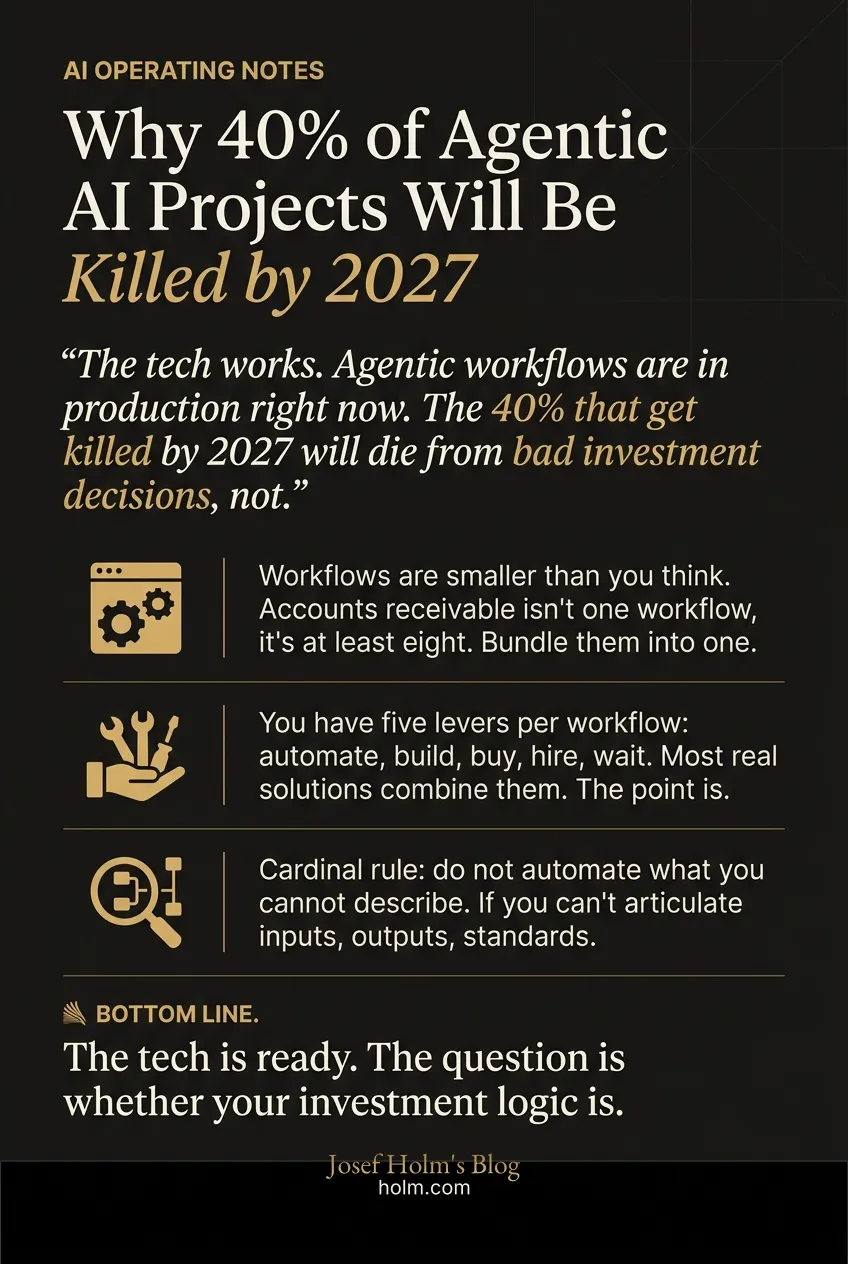
- The tech works. Agentic workflows are in production right now. The 40% that get killed by 2027 will die from bad investment decisions, not bad technology.
- Workflows are smaller than you think. Accounts receivable isn't one workflow, it's at least eight. Bundle them into one RFP and you get a mediocre tool that does none of them well.
- You have five levers per workflow: automate, build, buy, hire, wait. Most real solutions combine them. The point is knowing which levers you're pulling and why.
- Cardinal rule: do not automate what you cannot describe. If you can't articulate inputs, outputs, standards, exceptions, and ownership in plain English, the next investment isn't a tool. It's the work of describing it.
- The tech is ready. The question is whether your investment logic is.
Why 40% of Agentic AI Projects Will Be Killed by 2027 (And It's Not the Tech's Fault)
Gartner says more than 40% of agentic AI projects will be shut down by the end of 2027. The reasons cited: cost, unclear business value, weak risk controls. Everyone reads that and blames the technology. They're wrong.
The tech works. Agentic workflows are running in production right now, which is exactly why capital keeps flowing into the space. The failures aren't technical. They're failures of investment logic.
Most executives are asking the wrong question at the wrong altitude. They treat AI as a single, company-level strategy call. It isn't. It's a workflow-level capital allocation decision, repeated many times across the business.
What Most Executives Are Getting Wrong
Here's what I keep seeing. A leader walks into a vendor meeting and gets pitched a polished "AI solution" for their function. A second vendor pitches a completely different shape of solution for the same function. Then a third. None of them describe the actual work the team does.
A finance leader recently told me she'd been pitched three different "order-to-cash" agents in two weeks. Three vendors. Three completely different scopes. Zero of them matched how her team actually operates.
That's the core problem. Buyers don't have a clear picture of the shape of their own work, and the market is full of pre-shaped solutions being pushed at them. Money goes in, value doesn't come out, the project gets killed, and the headline reads "AI failed."
AI didn't fail. The investment decision did.
What Is a Workflow, Actually?
A workflow is not a prompt. It's not a use case slide. It's the entire operating loop:
- What information comes in
- What the system is allowed to do
- What good output looks like
- Who checks what
- What gets escalated
- Who is accountable for the result
The model is a small part of that loop. An important part, but a small one.
Most teams skip past defining the loop and jump straight to tools. That's why you can't have a useful AI conversation with them. There's no shared vocabulary for the actual work.
Workflows Are Smaller Than You Think
"Accounts receivable" isn't a workflow. It's a bundle of at least eight: collections prioritization, invoice matching, customer follow-up, exception handling, cash application, dispute resolution, reporting, escalation. Each routes to a different investment decision. Bundle them into one RFP and you'll get a mediocre tool that does none of them well.
Same with product. User research synthesis, spec drafting, backlog grooming, design review, experiment analysis, roadmap judgment, launch coordination, customer escalation. Some are buys. Some are builds. Some you wait on. Some you don't touch.
This is the work most leadership teams haven't done. And it's the work that decides whether your AI spend produces returns or ends up in the 40%.
The Five Levers: What Are Your Real Options?
Once you can describe a workflow precisely, you have five choices for what to do with it.
1. Automate
The easiest call when the work repeats often, follows a clear pattern, has recognizable exceptions, and good output is cheap to verify. Think IBM's internal HR query agent or Intercom's Finn for high-volume customer support.
The trap: don't automate when the exception cases hold most of the value. A lot of enterprise AI demos look great because they show the routine case. Production traffic is dominated by exceptions, and that's where accuracy collapses. If your real work lives in the edge cases, automation alone is the wrong lever.
2. Build
Right when the workflow is unique, full of edge cases, or depends on company-specific context. Your data, your standards, your approval gates, your risk thresholds. Your secret sauce.
Building today usually means agentic loops with skills, connectors, sub-agents, and sometimes purchased tools embedded inside. Harder than people think, more achievable than it was a year ago.
Here's the question executives almost never ask before approving a build: do you know what good looks like at the end of the workflow? If you don't, the team building it will be incentivized to declare success regardless. Your job is to be the honest evaluator. Most leaders skip this and then wonder why the output is mediocre.
3. Buy
Harder than traditional software buying because these tools sit on top of your specific data and systems. Three patterns:
- Primitives. Building blocks like Stripe's agentic APIs. Easy to start, easy to compose.
- Connective tools. Layers that let agents talk to agents, share context, coordinate.
- Full vendor workflows. Things like Harvey for legal. These only work if there's 80 to 90% overlap between the vendor's shape of work and yours. Less than that, and adaptation costs explode. In the deterministic software era you could force-fit a tool to your process. In the AI era you can't, because the model behavior depends on the shape of the workflow itself.
4. Hire
Most companies are hunting a purple unicorn: domain expert plus AI builder plus systems architect plus executive plus change leader. That person doesn't exist at scale. While you wait, the available talent gets hired by someone else.
Better approach: identify the specific capability your workflows will need in 6 to 12 months. Domain trust. Workflow design. Evaluation rigor. Executive ownership. Hire against that, not against a fantasy.
The hiring market itself is broken right now. AI-generated resumes, deepfaked interviews, vague job descriptions that no two people read the same way. Fog on both sides. If someone on your team can level up within six months, train them. Faster than the external market right now.
5. Wait
Counterintuitive, but it's a real lever. Waiting is not refusing AI. It's sequencing.
Your change-management capacity is finite. Spend it on the highest-use workflows first. Don't rewrite a working SQL layer when natural-language analytics on top of it gives you more build on. Stack the investments. Lower-priority workflows can wait six months without anything breaking.
Most real solutions combine levers. You hire in order to build. You buy primitives inside a custom build. You automate the 80% and route the 20% to humans. The point isn't to pick one lever per workflow. It's to know which levers you're pulling and why.
The Cardinal Rule
Do not automate what you cannot describe.
If you can't articulate inputs, outputs, standards, exceptions, and ownership in plain English, you cannot make a good investment decision. You'll hide 20 different workflows inside one vague request. You'll write a job description three people interpret three different ways. You'll buy a tool that solves a problem you don't actually have.
This is the single most useful filter I know for AI spend. If the workflow can't be described cleanly, the next investment is not a tool. It's the work of describing it.
The Investment Matrix
Two axes. How specific the work is to your company on one. How mature the AI market is for that work on the other.
Four quadrants:
Common work, mature market. Buy. Workday for HR, Stripe for payments, standard help desk tooling. Don't build what the market already does well.
Common work, immature market. Prototype narrowly or wait. Don't sign long contracts in fast-shifting categories. If you're ambitious, build to win the category before it consolidates.
Company-specific work, useful primitives available. Buy the primitives. Own the workflow. This is where most ambitious operators should be living right now. Buy the connectors, models, and orchestration. Own the standard and the judgment.
Company-specific work, thin market. Build. Clear opportunity to own something competitors can't easily copy.
Hiring cuts across all four quadrants. If no one in the room can define what good looks like, the next investment is a person who can.
This is the work we do inside an AI readiness note: map the workflows, place them on the matrix, and assign each one a lever. Not glamorous. Also the difference between AI spend that compounds and AI spend that gets written off.
What's the Executive's Job in All This?
Not to evaluate every tool. Not to read every demo deck. Not to pick the model.
Your job is to understand your workflows in enough detail to allocate capital sensibly across the five levers. Define the outcomes that matter. Prioritize the workflows. Allocate the talent. Set teams up to execute. Be the honest evaluator of what good looks like.
Replace "let's build an AI strategy" with "let's look at our workflows and make discrete investment decisions about each one." A quieter conversation. It produces dramatically better results.
This is what an operator note engagement is built around. Not strategy decks. Workflow-level capital allocation, executed in cadence.
What About People?
The "AI versus humans" framing is the unserious version of this conversation. Where should people spend their time? Where can they level up? Where are the real talent gaps? How do task bundles inside a job family shift as automation absorbs the repetitive parts?
As agentic systems move closer to the core of the business, the remaining human work gets more applied, not less. Higher judgment. Higher impact. That's a people problem to solve well, not a people problem to solve away.
The Takeaway
If you want to stay out of Gartner's 40%, do three things.
Describe your workflows precisely. Talk about them with shared vocabulary. Have discrete investment conversations about each priority workflow using the five levers.
Conversations that start with "we need an AI strategy" almost always fail. Conversations that start with a clearly described workflow almost always end in better capital allocation. That's the whole game right now.
The tech is ready. The question is whether your investment logic is.
Infographic
Frequently Asked Questions
- Why will 40% of agentic AI projects be killed by 2027?
- Gartner cites cost, unclear business value, and weak risk controls. The deeper cause is that executives treat AI as a single company-level strategy call instead of a workflow-level capital allocation decision. Money goes in, value doesn't come out, the project gets killed.
- What counts as a workflow?
- Not a prompt and not a use case slide. A workflow is the full operating loop: what information comes in, what the system is allowed to do, what good output looks like, who checks what, what gets escalated, and who is accountable. The model is a small part of that loop.
- What are the five levers for each workflow?
- Automate, build, buy, hire, wait. Automate when work repeats with cheap-to-verify output. Build when the work is unique to you. Buy when there's strong vendor overlap or useful primitives. Hire against a specific capability you'll need in 6 to 12 months. Wait when sequencing matters more than speed.
- When should you build instead of buy?
- Build when the workflow is unique, full of edge cases, or depends on your data, standards, approval gates, and risk thresholds. Buy a full vendor workflow only when there's 80 to 90% overlap between the vendor's shape of work and yours. Less than that and adaptation costs explode.
- What is the cardinal rule for AI investment?
- Do not automate what you cannot describe. If you can't articulate inputs, outputs, standards, exceptions, and ownership in plain English, you can't make a good investment decision. You'll hide 20 workflows inside one vague request and buy a tool that solves a problem you don't have.
- What is the executive's actual job here?
- Not to evaluate every tool or pick the model. Understand your workflows in enough detail to allocate capital sensibly across the five levers. Define the outcomes that matter, prioritize the workflows, allocate the talent, and be the honest evaluator of what good looks like.