The AI Fight Isn't About Models. It's the Wrapper.
Key Takeaways
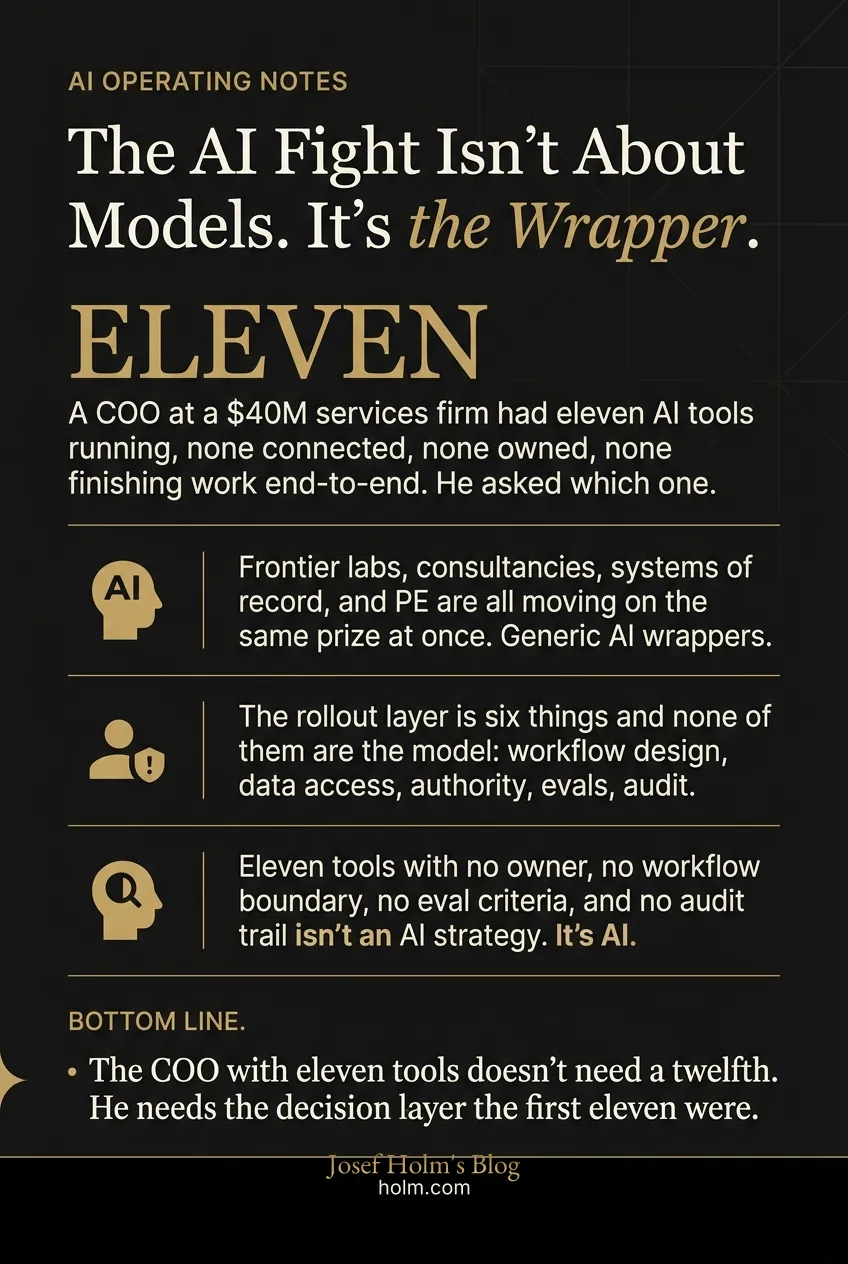
- A COO at a $40M services firm had eleven AI tools running, none connected, none owned, none finishing work end-to-end. He asked which one to keep. Wrong question.
- Frontier labs, consultancies, systems of record, and PE are all moving on the same prize at once. Generic AI wrappers are getting compressed from four directions simultaneously.
- The rollout layer is six things and none of them are the model: workflow design, data access, authority, evals, audit trails, and recovery with ongoing ownership.
- Eleven tools with no owner, no workflow boundary, no eval criteria, and no audit trail isn't an AI strategy. It's AI Fragmentation, and it's the structural cause underneath almost every stalled initiative.
- The COO with eleven tools doesn't need a twelfth. He needs the decision layer the first eleven were missing.
The Real Fight Isn't About Models. It's About What Wraps Around Them.
A COO at a $40M services firm told me last month he had eleven AI tools running across his business. Sales, support, ops, finance, marketing. None of them connected. None of them owned a workflow end-to-end. None of them had a clear owner inside the firm. He was paying for all of them and getting compounding value from none.
He asked me which one to keep.
Wrong question, and it's the one almost every mid-market operator is asking right now. The right question: what wraps around these tools so they actually finish work?
That wrapper has a name. It's the rollout layer. Firms that build it correctly over the next eighteen months will pull away from the ones that don't, in throughput and in margin, while the ones still buying generic AI wrappers will be paying for software that quietly hits a ceiling.
What is actually shifting underneath the AI market right now?
Three forces are converging at the same time, and most operators are only tracking one of them.
Private equity is rethinking the SaaS investment thesis. The old line in finance was that all SaaS companies taste like chicken: same growth shape, same balance sheet, same multiples, same exit playbook. That model is breaking. PE firms with funds dated 2026, 2027, and 2028 are sitting on SaaS portcos they bought as healthy assets and now have to figure out how to sell them into a market where AI pressure is compressing the metrics that made them buyable in the first place.
Frontier labs are moving down-stack. Anthropic and OpenAI have figured out you can't sell enterprise outcomes from a Silicon Valley conference room. Anthropic announced a deployment company with Blackstone, Hellman & Friedman, and Goldman Sachs, reportedly backed by $1.5 billion. OpenAI is pursuing a similar venture valued near $10 billion. Its Frontier Alliance pulled in McKinsey, BCG, Accenture, and Capgemini. PwC is collaborating with OpenAI on the office of the CFO.
What the labs are now saying out loud is what they used to imply: the bottleneck isn't the model. It's how agents get built and operated inside companies.
Enterprises themselves shifted somewhere around December. After two years in chat and copilot mode, operators started to see what agents can actually finish end-to-end. The capability jump is real. Understanding inside C-suites is catching up to it.
Which brings us back to the COO with eleven tools.
Why is generic AI getting squeezed from four directions at once?
This is the part most builders and most buyers underestimate.
Frontier labs are no longer just shipping models and waiting for the network to build around them. They're standing up deployment companies, hiring forward-deployed engineers in the Palantir mould, and shipping product-level offerings: Claude Code competing with Cursor, Claude design templates, finance agent templates. That doesn't mean Claude is going to replace the Bloomberg terminal. It tells you exactly where the labs think AI can finish workflows. A public cheat sheet for where they see value.
Consultancies are moving up-stack at the same time. McKinsey, BCG, Accenture, Capgemini, and PwC are no longer doing change management around someone else's AI rollout. They're building deliberate agentic practices, training delivery teams on production patterns, and bringing engineers into client engagements. Their twenty-year relationships at the CEO and CFO level are an unfair advantage no AI-native startup can replicate by Tuesday.
Systems of record are exposing structured interfaces. Salesforce, ServiceNow, Workday. SAP acquired Dremio and partnered with Prior Labs for a governed-data play. These vendors are clear: they don't want startups sitting between their data and your agents. They want agents calling their platforms directly, with their permissions and their audit trails.
Private equity is becoming a distribution channel. A single PE partnership can introduce a deployment partner across fifty portcos, compare results, and standardise playbooks. That's a fundamentally different shape than vendor-by-vendor enterprise sales.
If you're a builder shipping a generic AI wrapper, you're getting compressed by all four pressures at once. If you're a buyer, the vendors pitching you today are mostly priced and positioned for last year's market.
So what does the squeeze leave standing?
What actually is the build layer?
Here the language has to get specific, because vendors throw around words like "agent value" and "AI transformation" and operators nod along without ever asking what's inside the box.
The launch layer is six things, and none of them are the model.
Workflow design. Which decisions the agent makes. Which steps stay human. Where the handoffs are. What counts as "done." Each step needs an owner, an input, and an output. Most teams skip this entirely and ship a model attached to a tool.
Data access. Which sources of truth the agent reads. Which permissions apply at row and field level. Which records are authoritative and which are stale. Most firms can't answer this for their humans, let alone their agents.
Authority. What the agent is allowed to do, against which systems, with what spending or commitment limits. Read access and write access have completely different risk profiles. Spending is often irreversible. Most pilots blur this line.
Evals. How agent output gets measured for correctness, completeness, and safety before it goes anywhere. Evals are not benchmarks. They're scored adherence to specific business rules.
Audit trails. What gets logged. What must be logged. What an auditor can reconstruct after a failure. This is where most firms discover, post-incident, that they have nothing.
Recovery and ongoing ownership. How wrong actions get reversed. Who keeps the system tuned over time. Who owns it on the org chart, not just in the slide deck.
A vendor selling "agent value" without building these six components isn't delivering what they're claiming. The value lives in the layer around the model, not in the model itself. Same pattern as the dual-threat Josef Holm installs inside operating firms: throughput compounds and the data-exposure surface stays inside an enforced governance line, on the same page, on the same engagement.
So what should an owner-operator actually do about this?
Most of what I see inside mid-market firms is the same pattern the COO described. Eleven tools. No owner. No workflow boundary. No eval criteria. No audit trail. No idea what data is being sent where. That's not an AI strategy. It's AI Fragmentation, and it's the structural cause underneath almost every stalled AI initiative I've reviewed this year.
The reflexive answer is to hire a Chief AI Officer, run a programme, or buy another tool that claims to unify the others. All three are expensive. None of them fix the underlying problem, which is that the firm has never made a decision about which AI work to kill, which to fix, and which to build.
That decision is what the AI readiness note produces. Fixed-scope, bounded. It maps every AI workflow, tool, and pilot the firm is running, applies a Kill, Fix, Build verdict to each one, and delivers an Opportunity Map prioritised by margin impact and exposure risk. That's the entry point. For firms that need ongoing oversight, the operator note ongoing work is the firm-level equivalent of a AI leadership, principal-led, and built to install the decision layer the firm is missing.
To see the shape of the work and who we run it with, the services overview lays it out, and who we work with shows the firm shapes the model fits.
What changes for builders, buyers, and PE firms?
For builders, the directive is sit closer to the business object. Generic intelligence becomes valuable when it's attached to specific objects and actions that define real work. A support product has to understand cases, policies, customers, entitlements, escalation paths. A sales product needs an object model that spans the funnel. If your product can be described without naming a specific business object, you're shipping a wrapper, and the four pressures will find you.
For buyers, stop being swayed by "the model is great" or "we trust your data." Slogans, not answers. Ask discrete questions about how the vendor's solution interacts with your data objects, your workflows, your authority limits, your audit requirements. Bring an engineer to the procurement conversation. Vendors with real rollout-layer answers will welcome it. The wrappers will fold.
For PE firms, the test is whether a product could plausibly be deployed across fifty portcos with a single partnership, or whether it's stuck in one-to-one enterprise sales. And whether your portco CEOs understand the setup detail well enough to defend the value of what they own at the next exit.
Where does this go next?
It's not a foregone conclusion that Claude, OpenAI, or any single player will own enterprise agent workflows. That's precisely why every serious player is staking a claim right now. The build layer is wide open, which means the firms that build it deliberately, inside their own four walls, with a clear decision layer and a governance line that holds, will compound advantage vendors cannot sell them and competitors cannot copy.
The COO with eleven tools doesn't need a twelfth. He needs the decision layer the first eleven were missing.
If that's the conversation you're ready to have, Read more from Josef.
Infographic
Frequently Asked Questions
- What is the rollout layer in AI deployment?
- It's the wrapper around the model that decides what work the agent actually finishes. Six components: workflow design, data access, authority, evals, audit trails, and recovery with ongoing ownership. Without these, you're paying for a model attached to a tool, not an outcome.
- Why are generic AI wrappers getting squeezed?
- Four pressures at once. Frontier labs are moving down-stack with their own deployment companies. Consultancies like McKinsey and BCG are building agentic practices. Systems of record like Salesforce and SAP are exposing direct interfaces. And PE is becoming a distribution channel across portfolios. Generic wrappers have no defensible position against any of these.
- What is AI Fragmentation and how does it stall rollouts?
- It's the pattern where a firm is running ten or more AI tools with no owner, no workflow boundary, no eval criteria, no audit trail, and no clarity on what data is going where. It's the structural cause underneath most stalled AI initiatives. The fix isn't another tool. It's a decision about which to kill, which to fix, and which to build.
- What does the AI readiness note deliver?
- Fixed scope, bounded. It maps every AI workflow, tool, and pilot the firm is running, applies a kill, fix, build verdict to each one, and produces an Opportunity Map prioritised by margin impact and exposure risk. It's the entry point to installing a real decision layer.
- What should a buyer ask an AI vendor in procurement?
- Discrete questions, not slogans. How does the solution interact with your specific data objects, workflows, authority limits, and audit requirements? Bring an engineer to the conversation. Vendors with real rollout-layer answers will welcome the scrutiny. The wrappers will fold.
- Should I hire a Chief AI Officer to fix this?
- Usually no, not yet. Most mid-market firms don't have the decision layer that a CAIO needs to operate inside. Install the decision layer first through an AI readiness note, then decide if you need a full-time CAIO or a principal-led operator note ongoing work.