Data Sovereignty for DIFC Firms Running AI
Last quarter, a DIFC-licensed wealth manager I work with discovered something uncomfortable. Their analysts had been pasting client portfolio statements into ChatGPT for six months. Free tier. Personal accounts. The data was in OpenAI's logs, possibly used for training depending on the account tier, and there was no contractual basis on which they could ask for it back.
The firm had a written AI policy. The policy said "do not use unsanctioned AI tools." Nobody had read it since onboarding. The exposure was not theoretical. The firm's largest LP was in the middle of renewing its mandate and had just added an AI-disclosure clause to the next side letter.
This is the data sovereignty problem in 2026. It is not whether your firm is running AI. It is where the data actually lives, who can see it, what jurisdiction governs it, and whether the answer survives a regulator visit.
This piece is the long-form version of the Data Sovereignty for AI landing page. It exists because Managing Partners at DIFC, ADGM, and broader UAE mid-market firms keep asking the same five questions and the answers are not generic.
What data sovereignty actually means in the AI context
Pre-AI, data sovereignty was mostly a hosting-region question. Your client data sat in a database, the database was in a region the regulator recognized, the auditor could trace the storage layer, done.
AI breaks that model in three places.
First, prompts and uploads do not behave like database writes. They are conversations. The provider's terms govern what happens to them; the firm's storage policy mostly does not. When an analyst pastes a portfolio statement into ChatGPT, the data is no longer in the firm's storage layer. It is in OpenAI's. The hosting region of OpenAI is different. The retention policy is different. The sub-processor list is different.
Second, embedded AI features inside SaaS the firm already pays for run on the firm's data corpus by default. Microsoft 365 Copilot, iManage AI, Salesforce Einstein, Zoom AI, Otter, Fireflies. The base SaaS contract may specify EU hosting; the AI feature attached to it may route through US-hosted model providers. The data crosses borders the firm did not realize it crossed. The DPA covers the base SaaS; the AI clause is often a separate addendum that nobody at the firm has signed off on.
Third, sub-processor chains in the AI vendor ecosystem are deep. A vendor's marketing page says they handle the AI. Two layers down, they are calling OpenAI or Anthropic. The model provider then has its own training-data terms. A regulated firm assumes one contract; the actual data flow is three contracts deep with different terms at each layer.
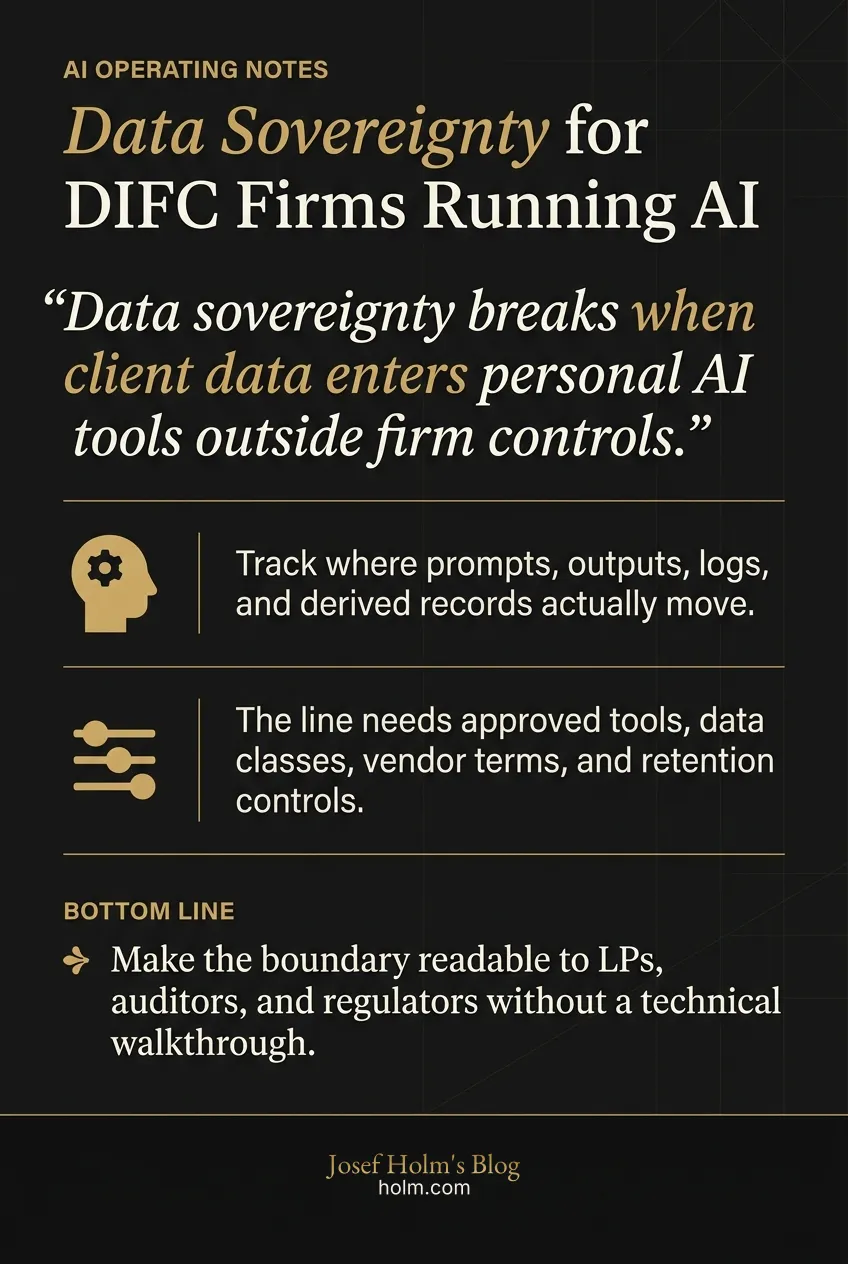
This is why the question "do we have an AI policy" is now the wrong question. The right question is: where does our data sit, who can see it, under what contract, in what jurisdiction, and can I write that down in a single document my LP can read.
The four surfaces where sovereignty breaks
Every AI readiness note we run for a regulated mid-market firm finds the same four sovereignty breaks. They are predictable enough that we now structure the diagnostic around them.
1. Model training data exposure
Free-tier and consumer accounts of ChatGPT, Gemini, Copilot, Perplexity, and similar tools route prompts and uploads into training pipelines under default terms. Material entered today persists in the corpus that trains tomorrow's models. There is no deletion right that covers it. The provider may delete a chat history from your account view, but the training pipeline has already consumed the content.
This is the surface most firms underestimate. The volume of free-tier use inside a regulated firm is almost always higher than the leadership team assumes. We have audited firms whose written policy explicitly banned free-tier ChatGPT and whose actual usage was widespread because the policy was never enforced and the alternative was not provided.
The fix is mechanical. Enterprise licenses for OpenAI, Anthropic, and Google offer "do not train" defaults and contractual basis to enforce them. The cost differential is two to three times the consumer plan. The exposure differential is total.
2. Hosting region mismatch
AI providers default to US or EU regional hosting. A firm in DIFC, ADGM, or a non-default jurisdiction usually does not realize this until they read the licensing agreement carefully. By the time they read it, six months of usage has crossed borders the firm has not declared.
Data-residency clauses in client agreements quietly break in this surface. A wealth manager whose private client agreement promises "all client data remains in the GCC region" cannot keep that promise if their analysts use ChatGPT free tier, which routes through US infrastructure. This is not an esoteric exposure. It is a contractual breach the firm has signed and is currently violating.
The fix here is harder than the training-data fix. Some vendors offer regional hosting at higher license tiers. Others do not. For some workloads, the right answer is a sovereign-grade local alternative; for others, it is killing the workflow. The triage runs through the Keep, Fix, or Kill framework, applied per tool against the firm's specific jurisdictional perimeter.
3. Sub-processor blind spots
This is the surface the firm's procurement team is least equipped to handle. Most enterprise AI vendors run on third-party model providers. Vendor X's product is the wrapper; OpenAI or Anthropic is the model underneath. The DPA names the sub-processor, often in an appendix nobody reads.
A regulated firm signing with Vendor X assumes one data contract. The reality is two: Vendor X's terms govern the wrapper layer; the sub-processor's terms govern the model layer. When the model provider changes its training-data policy, the firm's exposure changes, and the firm finds out via the sub-processor's blog rather than a contractual notice.
The fix is a sub-processor and DPA review per AI vendor. The Audit pulls each AI vendor's current sub-processor list against the firm's regulatory perimeter and writes a verdict per layer. Vendors who do not disclose their sub-processor list at all are the easiest verdicts: they leave the inventory.
4. DPA and sovereign-license gap
Enterprise licenses for ChatGPT Enterprise, Claude for Work, Microsoft 365 Copilot, and Gemini Workspace carry different sovereign-residency options at different price points. Most firms procure the default tier because that is what the sales conversation defaults to. The upgrade required to satisfy jurisdictional residency, training opt-out, sub-processor disclosure, and proper DPA terms is left on the table.
The differential is usually two to four times the default license cost. For most regulated mid-market firms we work with, the upgrade is justified for the heavy-use tools and not for the lighter ones. The Audit produces the per-tool decision against the per-tool data class.
What is specifically harder in DIFC, ADGM, and the UAE
The geography matters. DIFC and ADGM operate common-law systems with regulators (DFSA, FSRA) actively converging on AI guidance. The UAE federal layer adds the Personal Data Protection Law and sector-specific regulators (Central Bank of UAE, SCA). Free zones add their own layers.
A mid-market firm in DIFC therefore typically operates against three to five jurisdictional perimeters at once: DIFC's data protection law and DFSA supervision, UAE federal PDPL, sometimes ADGM if there is a parallel entity, and frequently EU or US data residency commitments inherited from client agreements.
Each layer asks the sovereignty question slightly differently. DFSA emphasizes governance and accountability. FSRA emphasizes data residency and operational resilience. UAE PDPL emphasizes consent and cross-border transfer mechanisms. The EU layer, where it applies, emphasizes lawful basis and processor accountability.
Generic AI policy templates do not survive this multi-layer review. They produce a document that satisfies none of the five layers fully and reads as boilerplate to a regulator who has seen the template before. The fix is not more template; it is jurisdiction-specific scoping per layer the firm actually answers to.
This is the work Josef Holm does inside the Audit for UAE mid-market firms. The output is a sovereignty posture document scoped against the specific layers the firm operates inside, not a generic policy.
What "installing the line" looks like in practice
The output of an AI readiness note with sovereignty as the primary lens is four artifacts.
First, a jurisdiction-mapped AI inventory. Every AI tool the firm uses, mapped against the data classes it touches and the jurisdictional rules those classes are bound to. The format is a single document, not a spreadsheet with twelve tabs. Leadership can read it in fifteen minutes and the regulator can read it in five.
Second, a sub-processor and DPA review per vendor. The current state of each vendor's sub-processor disclosure, the DPA terms, the regional hosting options, and the gap between current state and what the firm's perimeter actually requires. Where the gap exists, the document names the path: contract amendment, license upgrade, replacement, or kill.
Third, a remediation roadmap. Sequenced over sixty to ninety days. Each step has a named owner inside the firm and a turnaround commitment. The Audit does not deliver the remediation; it delivers the plan. Most firms continue into implementation notes or run the remediation with their own team.
Fourth, a sovereignty posture document. One page. Shareable with LPs, regulators, sophisticated clients, or auditors when asked. Approved tools per jurisdiction, sub-processor list, residency posture, sovereign-license tier, named owner of the line.
The last artifact is what most leadership teams underestimate the value of. The exposure is not solved by the existence of governance; it is solved by the firm's ability to produce, in writing, on request, what its governance line is. The artifact exists so the answer to the next LP DDQ question is not a story; it is a document.
Common questions
Where does this sit alongside our compliance officer or general counsel?
Compliance and legal own the regulatory perimeter. Josef Holm installs the AI operating layer above it. The Audit runs jointly with the firm's compliance lead or general counsel. The output is a governance line they can defend in a regulatory review and a remediation plan they can authorize through normal procurement.
Do we need to switch every vendor?
Almost never. The Audit produces a verdict per tool: keep, fix via vendor upgrade, fix via replacement, or kill. Most firms walk out with two to four vendor upgrades, one or two replacements, and the rest staying as-is under a tighter governance line. The data sovereignty review identifies which subset of tools needs the upgrade specifically for sovereignty reasons, separate from the throughput-driven changes.
How long does the engagement take?
Two to six weeks depending on firm size, number of entities, and number of jurisdictions. A single-entity DIFC wealth manager typically completes in three weeks. A multi-entity family office across DIFC, ADGM, and an offshore vehicle is closer to five.
What does it cost?
The AI readiness note with sovereignty as primary lens is for a single entity. Multi-entity and cross-jurisdictional engagements scope larger. The AI leadership ongoing work that typically follows the Audit is quoted in the Audit readout based on operating surface.
What do we get at the end?
The four artifacts above: jurisdiction-mapped inventory, sub-processor and DPA review, remediation roadmap, and shareable sovereignty posture document. Plus a working relationship into the operator note engagement if leadership wants the line maintained quarterly under Josef Holm rather than handed off internally.
Bottom line
Data sovereignty was a hosting-region question. AI made it a contract-stack question. For regulated UAE and DIFC mid-market firms, the contract stack now runs three to five layers deep across multiple jurisdictions, and most firms have not done the work to map it.
The firms that have done the work answer the next LP DDQ question without rewriting their posture in panic. The firms that have not, do. The work is bounded, the engagement model is well-tested, and the cost is small relative to a mandate at risk.
If you sit inside a regulated DIFC, ADGM, or UAE federal-licensed firm and the AI sovereignty question is currently open, the entry point is the AI readiness note. Read more from Josef when leadership is ready to act on the answer.
Infographic
Frequently Asked Questions
- Where does this sit alongside our compliance officer or general counsel?
- Compliance and legal own the regulatory perimeter. Josef Holm installs the AI operating layer above it. The Audit runs jointly with the firm’s compliance lead or general counsel.
- Do we need to switch every vendor?
- Almost never. The Audit produces a verdict per tool: keep, fix via vendor upgrade, fix via replacement, or kill. Most firms walk out with two to four vendor upgrades and one or two replacements.
- How long does the engagement take?
- Two to six weeks depending on firm size, number of entities, and number of jurisdictions.
- What does it cost?
- The AI readiness note with sovereignty as primary lens is for a single entity. Multi-entity and cross-jurisdictional engagements scope larger.
- What do we get at the end?
- Jurisdiction-mapped inventory, sub-processor and DPA review, remediation roadmap, and a shareable sovereignty posture document.