The Prove-It Economy Lands at the Partner's Desk
Key Takeaways
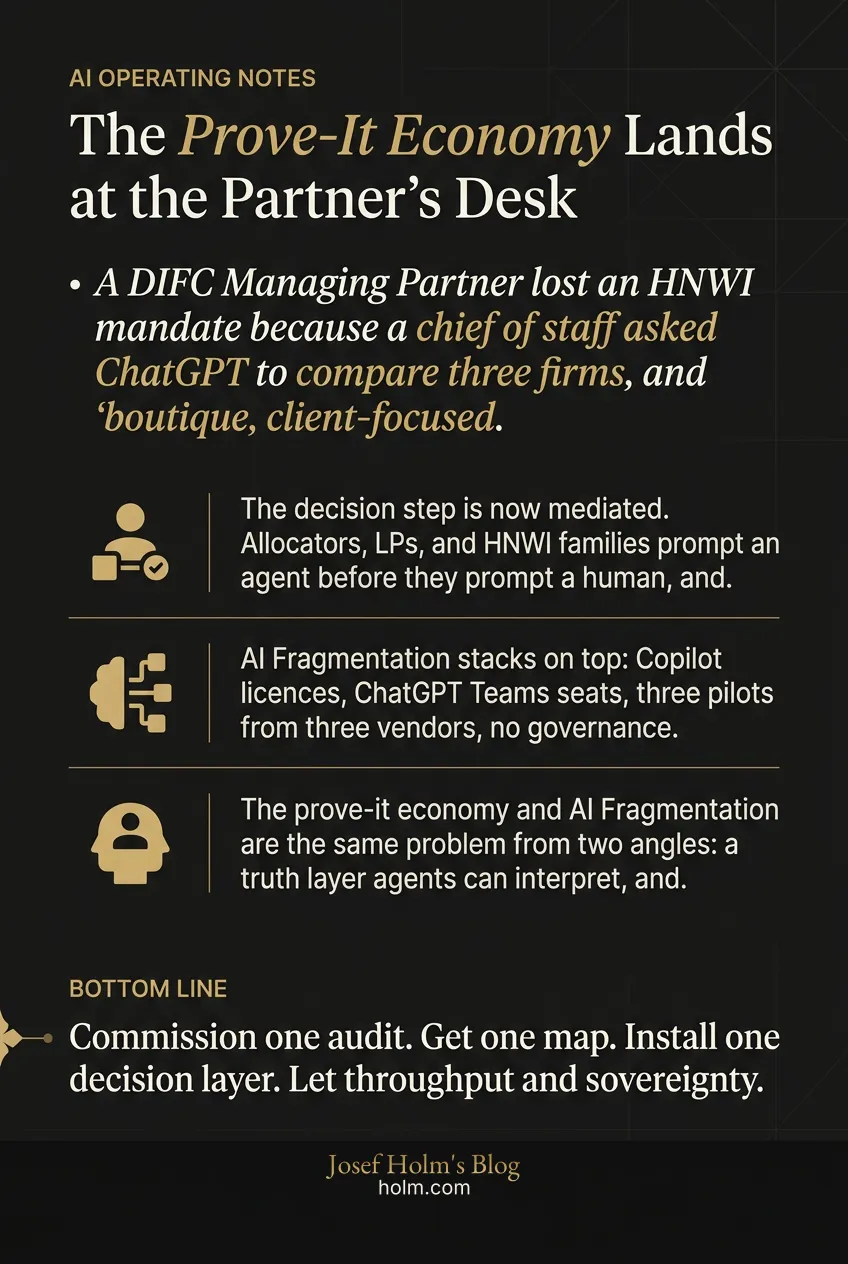
- A DIFC Managing Partner lost an HNWI mandate because a chief of staff asked ChatGPT to compare three firms, and 'boutique, client-focused, experienced' got averaged out of the consideration set.
- The decision step is now mediated. Allocators, LPs, and HNWI families prompt an agent before they prompt a human, and the agent only interprets structured signal you have already exposed.
- AI Fragmentation stacks on top: Copilot licences, ChatGPT Teams seats, three pilots from three vendors, no governance line, and Shadow AI widening the data surface while the website still reads like 2019.
- The prove-it economy and AI Fragmentation are the same problem from two angles: a truth layer agents can interpret, and a decision layer the firm can defend. One mandate, one team, one Opportunity Map.
- Commission one audit. Get one map. Install one decision layer. Let throughput and sovereignty compound on the same page.
The Prove-It Economy Lands at the Managing Partner's Desk
A Managing Partner at a DIFC wealth firm tells me a prospective HNWI client never replied after the first intro call. Six weeks later the prospect's family office signs with a competitor a third the size. He digs. The prospect's chief of staff had asked ChatGPT to compare three firms. The competitor showed up with structured, opinionated, verifiable claims. His firm showed up as "boutique, client-focused, experienced." The AI averaged him out of the consideration set.
This is not a marketing problem. It's an interpretation problem. And it's already at his door.
What Changed Without Anyone Telling You?
For 25 years the internet ran on attention. Ads, SEO, LinkedIn posts, brand shouting, the buyer looking and the buyer deciding.
That decision step is now mediated. Allocators, prospective LPs, HNWI families, in-house counsel hiring outside firms; they ask an AI before they ask a human. They prompt Claude or ChatGPT or a procurement-grade agent for a comparison. They paste in a DDQ extract and ask which manager profile fits. They hand the model three pitch decks and ask it to summarise tradeoffs.
The agent does not read your brochure. It does not feel your tagline. What it does is retrieve whatever structured signal you have exposed, compress it, and hand a verdict to the human. The marketers writing about this call it the interpretation economy, and they're right. The earned, less polite name is the prove-it economy: claims without structured evidence collapse into the category average.
For a regulated mid-market firm, the cost is not theoretical. It's mandates lost before the first meeting.
Why Does AI Fragmentation Make This Worse?
Here is where the second problem stacks on top of the first.
Most firms I sit with have already responded to AI by buying tools. Copilot licences. A ChatGPT Teams seat. Three pilots from three vendors, each pitching a different "AI strategy." None of it talks to each other. None of it produces a coherent outward signal. None of it has a governance line.
This is AI Fragmentation. It's the diagnosed problem Josef Holm was built to fix.
Fragmentation shows up as two simultaneous failures. Internally, partners cannot tell which workflows the AI is actually moving and which are theatre. Externally, the firm has no truth layer for any agent to interpret. The website still reads like 2019. The page is vague. The proof points are testimonials, not evidence. Meanwhile, an analyst pastes an LP communication into a public chatbot to "summarise it faster," and nobody has approved that motion.
That's Shadow AI widening the data surface at the exact moment the firm needs to be narrowing it.
What Does the Prove-It Economy Actually Demand?
Two things, and they sit on the same page.
One: a truth layer the firm can defend. Structured, opinionated, verifiable claims about what the firm does, for whom, with what evidence, under which regulator, with what track record. Not "boutique" and not "client-focused." Specific. Mandate types, jurisdictions, fee structures, custody arrangements, response times, the actual shape of the work. Agent-legible. The shoe brand that documents the spring system wins over the one that says "returns energy." The wealth firm that publishes its discretionary process, jurisdictional reach, and DFSA permissions wins over the one that publishes a yacht photo.
Two: a decision layer inside the firm. A governance line that says which AI tools the firm keeps, which it kills, which it builds around, and what data is allowed to cross which boundary. Without it, every external claim is undermined by an internal exposure surface no one can map.
Throughput and data sovereignty on the same page. This is the dual threat, and it's one job, not two.
So Who Is Supposed to Own This?
Here is the planted question the Managing Partner sitting with this problem actually faces.
Marketing cannot own it alone. Marketing in most regulated mid-market firms is a content factory, not a decision-making seat. They write the LinkedIn posts. They do not get to touch, product claims, regulatory positioning, or sales collateral structure.
IT cannot own it. IT manages licences and endpoints. They do not know which LP DDQ language survives compression in an agent's summary.
Compliance cannot own it either. Compliance writes the policy that says do not paste client data into ChatGPT. They do not architect the substrate that makes the policy enforceable while the firm still ships work faster.
The CEO does not have the bandwidth. The COO is running operations. The CFO is protecting margin.
Most firms I talk to assume the answer is hiring a Head of AI, or buying another platform, or running another pilot. That's the same fragmentation reflex that created the problem. More tools, more decks, more dashboards. More surface area, less clarity.
What Actually Fixes It?
The fix is structural, and it's smaller than people expect.
Start with the AI readiness note. Fixed scope, bounded, two to four weeks. We map every AI tool, licence, embedded feature, and Shadow AI motion already running inside the firm. We apply Kill, Fix, Build to each one. We map the data surface against the firm's regulatory posture (DFSA, FSRA, GDPR, jurisdictional residency). And we produce an Opportunity Map: the prioritised remediation roadmap that tells the partners which workflows compound throughput, which ones expose the firm, and which surfaces the firm needs to make legible to outside agents.
Then the operator note engagement installs the decision layer and the governance line, and stays on as the firm equivalent of a AI leadership. The internal substrate the firm runs AI on, and the external truth layer agents interpret the firm through, get built on one mandate, by one team, against one Opportunity Map.
Here's what most consulting decks will not tell you: the prove-it economy and the AI Fragmentation problem are the same problem from two angles. The firm that fixes one without the other will lose either margin or mandates. The firm that fixes both compounds in a market where most competitors are still buying licences.
Marketing, in this model, gets pulled back toward product, sales, and the regulator. It stops being a content factory. It becomes part of how the firm proves what it actually does. Spicy and specific, not bland and averaged-out. Agents reward the firm that has opinions. They flatten the firm that does not.
What Does the Owner-Operator Do This Quarter?
You stop buying tools. You stop running pilots. You stop letting Shadow AI widen the data surface while marketing decorates a website nobody is reading.
Commission one audit. Get one map. Install one decision layer. Let the throughput and the sovereignty compound on the same page.
The Managing Partner at the top of this piece called me eight weeks after losing that HNWI mandate. The Audit ran in three. The Opportunity Map flagged eleven workflows worth fixing and three worth killing outright, including the Shadow AI motion that would have triggered a hard conversation with the DFSA inside six months. The truth layer rebuild started the week after. The next prospect who ran the AI comparison shortlisted his firm.
That's the work. That's the wedge.
Infographic
Frequently Asked Questions
- What is the prove-it economy?
- It's what happens when buyers stop reading your brochure and start asking an AI to compare you against competitors. The agent retrieves whatever structured, verifiable claims you've exposed, compresses them, and hands a verdict to the human. Vague claims like 'boutique' and 'client-focused' get averaged out of the consideration set. Specific, opinionated, evidence-backed claims survive.
- How does AI Fragmentation make the prove-it economy worse for regulated firms?
- Fragmentation creates two failures at once. Internally, partners can't tell which AI workflows are moving real work and which are theatre. Externally, the firm has no truth layer for any agent to interpret. Meanwhile Shadow AI, like an analyst pasting an LP communication into a public chatbot, widens the data surface at the exact moment the firm needs to be narrowing it.
- Who inside a wealth or PE firm should own the AI response?
- Nobody currently in the org chart owns it cleanly. Marketing is a content factory. IT manages licences. Compliance writes the policy but does not architect the substrate. The CEO, COO, and CFO are bandwidth-constrained. Hiring a Head of AI or running another pilot is the same fragmentation reflex that created the problem. The fix is structural, not another seat.
- What is an AI readiness note and what does it produce?
- Fixed scope, bounded, two to four weeks. Josef Holm maps every AI tool, licence, embedded feature, and Shadow AI motion running inside the firm, applies Kill, Fix, Build to each one, and maps the data surface against the firm's regulatory posture. The output is an Opportunity Map: a prioritised remediation roadmap telling partners which workflows compound throughput, which expose the firm, and which surfaces need to be made legible to outside agents.
- What does a truth layer look like for a regulated wealth firm?
- Structured, opinionated, verifiable claims about what the firm does, for whom, with what evidence, under which regulator, with what track record. Mandate types, jurisdictions, fee structures, custody arrangements, response times, the actual shape of the work. Agent-legible. Not a yacht photo and a tagline.
- What does the owner-operator do this quarter?
- Stop buying tools. Stop running pilots. Stop letting Shadow AI widen the data surface while marketing decorates a website nobody is reading. Commission one audit. Get one map. Install one decision layer. Let throughput and sovereignty compound on the same page.